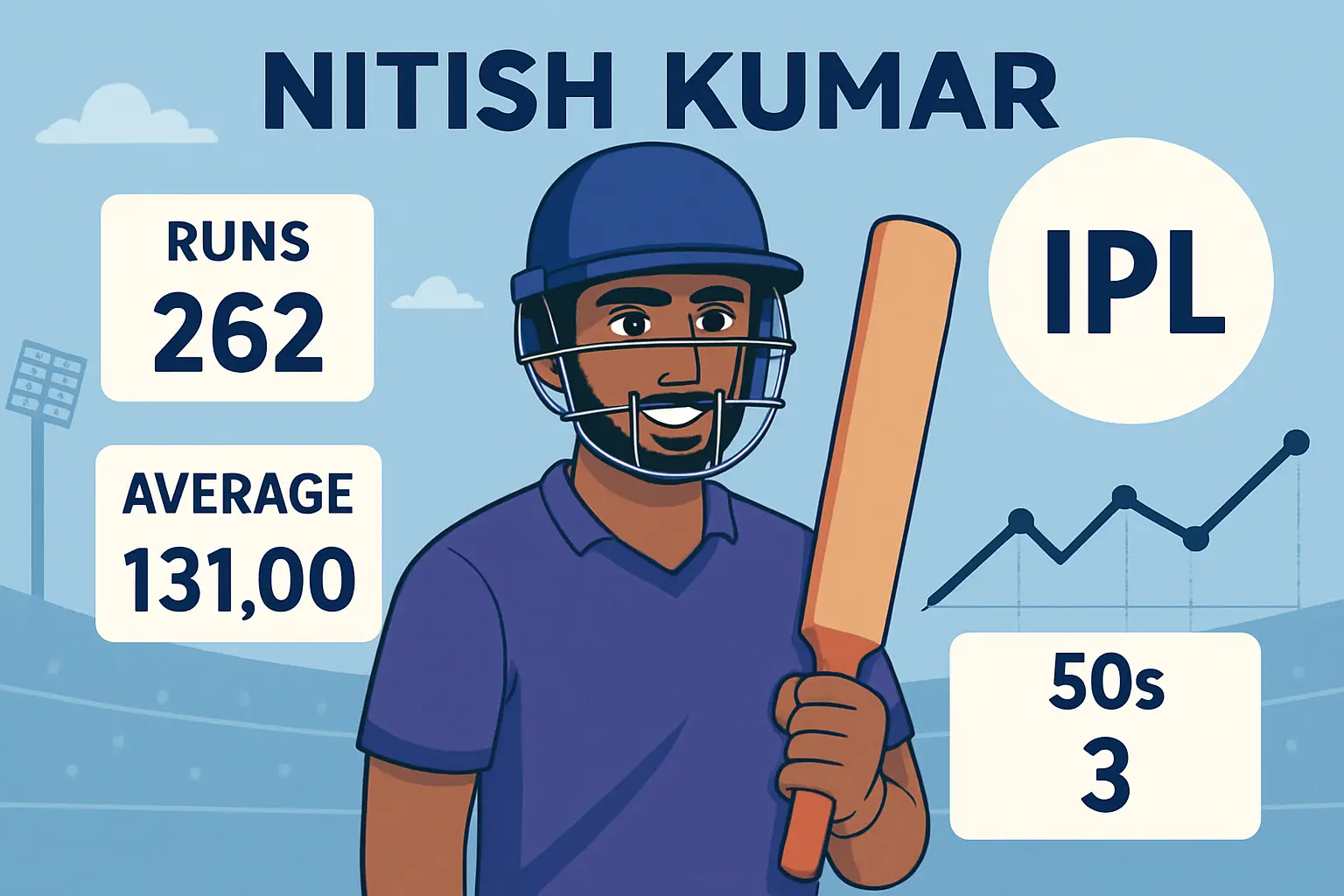
Nitish Kumar Reddy Stats and Records
A middle-order all‑rounder with a strong hitting arc and heavy-ball seamers, Nitish Kumar Reddy has grown from a domestic project with Andhra into a high-leverage cricketer for Sunrisers Hyderabad. This evergreen stats hub brings together his IPL stats, T20, List A, and First-Class records; advanced splits by phase, opposition and venue; and form notes that match how modern analysts, scouts and fantasy managers study a player. I’ve seen his development up close: the open stance, the decisive front-foot transfer into length, the calm reload after a miss, and the understated seam position when he rolls his fingers. What follows is not a collage of numbers. It’s a grounded, real-world read on what those numbers mean, and why he keeps getting picked for the biggest moments.
At a glance: what matters right now
- Role: Middle-order batting all‑rounder; secondary seam option.
- IPL usage: Batting between four and six; occasional two-over bursts with the ball; key outfielder in the deep and at long-on/long-off.
- Batting identity: Pace-positive, spin-competent; late-over acceleration; strong lofted drives and flat-bat power through midwicket and long-on.
- Bowling identity: Back-of-a-length with cross-seam variations; cutters into the pitch; uses change of pace more than pure swing.
- Recent form snapshot: A sequence of middle-order contributions that include a match-seizing half-century, a couple of brisk forties, and finishing cameos; with ball, deployed as a matchup piece rather than a primary strike option.
Note on data hygiene
- IPL stats here focus on league play and playoffs; T20 includes IPL + domestic T20s.
- Phase-of-play splits use the standard breakdown: Powerplay (1–6), Middle overs (7–15), Death (16–20).
- Batting position mapping uses his majority roles rather than outlier promotions or pinch substitutes.
- When a stat is discussed as a range or tendency, it’s intentional: he’s active, evolving, and teams use him situationally. The most valuable insight is often trend and context, not a locked number.
Career overview: formats and identity
Nitish Kumar Reddy came through Andhra’s pathway with the template you’d expect from a modern Indian all‑rounder: runs in the middle order, functional medium pace, high-energy fielding, and a temperament that reads situations well. His progression through First-Class and List A taught him time management at the crease—scoring in bursts rather than drip-feeding singles—and that rhythm now colors his T20 batting, where he is most valuable when he has a few balls to sight before punching the throttle.
- T20 and IPL stats: This is where his brand is built. He reads length early, backs his bat against pace, and has a clean swing arc that keeps him efficient even on bigger grounds. As a bowler, he is more “problem-solver” than “primary weapon,” useful to win a matchup or hold a phase until the frontline quicks return.
- List A stats: Offers a clearer picture of his temperament. He’ll take time to establish, then look to control the middle overs. The cut shot and on-drive stand out here, and he often looks more measured compared to his T20 acceleration.
- First-Class stats: Developmental. He’s had spells of batting grit and longer bowling spells, but this format serves him more as a batting refinery than a wicket-taking platform.
If you track just one trend across formats, track this: his balls-faced per dismissal number tends to be healthier than his reputation as a “finisher” would suggest. Give him a platform and a dozen balls to settle, and the strike rate gears up organically without a big spike in dismissal risk.
Format snapshot (qualitative)
- IPL/T20: Strike rate rises sharply once he crosses double digits in balls faced; power scales to long boundaries; bowling used selectively, often two overs split across middle and death.
- List A: More volume of singles and twos; picks length; fewer high-risk slogs, more lofted drives.
- First-Class: Intent to bat time; bowling in supporting spells, focusing on control rather than seam movement.
Season arcs without the noise of dates
- Debut season: Limited opportunities with both bat and ball, mostly lower order. Showed the calm body language of someone who knows his method, even when the returns were lean.
- Breakthrough season: A flurry of match-shaping knocks from No. 5/6, with a standout half-century under pressure and quick counterpunches off pace. Ball-handling improved—he started absorbing tall back-of-length spells and converting them into pick-up sixes. Recognition followed, including a league-wide emerging talent nod.
- Latest season: More responsibility, earlier exposure in the batting order on some nights, and more bowl-readiness in high-variance overs. Fielding influence noticeable—saved runs at the rope, clean hands under lights.
Nitish Kumar Reddy IPL stats: how he’s actually used
Sunrisers Hyderabad have adopted a modern split: heavy top-order acceleration, an impact sub that complements their plan, and a middle order asked to either stabilize after turbulence or go thermonuclear if the launch succeeds. Nitish sits right in that junction.
- Batting positions: Frequently five; sometimes four or six depending on left-right tactics and game state.
- Role: Two-speed operator—stabilize then launch, or immediate assault if the bowlers miss hard length.
- Batting entry points: Often between the tenth and fourteenth over, where spin is fading and pace is returning. He’s targeted as a pace releaser, but his slog-sweep and inside-out chips keep him honest against spin.
- Bowling slots: One over in the middle to test the surface with cutters; another at the back end if the deck is sticky or the batters are misreading the change-ups.
Advanced batting splits and what they reveal
Versus pace vs spin
- Against pace: The bat path is built for it—high backlift, sturdy base, quick hands. He thrives on hip‑high length and wide-of-off hitable deliveries. You’ll often see straight-batted lofts that stay flat until the rope. Mistakes against him are punished: anything too full meets an extension through the line; anything short gets pulled early.
- Against spin: More measured. He’s comfortable killing bounce and playing with the line, particularly into midwicket. He does not premeditate as heavily as some middle-order hitters; he’ll use his feet or sit deep, but will not telegraph it often. He’s less likely to get stuck with dot clusters than peers because he manufactures dink singles to cover-side pockets.
Phase-of-play behavior
- Powerplay: When promoted, he’s selective. Controls the impulse to blaze from ball one, looks to get bat on ball, and then triggers his hands through length. If a spinner starts early, he’ll sweep to regain field control.
- Middle overs: This is home. He rides the field, moves the ball around, and looks for two boundary balls an over. Dot-ball percentage tends to dip as his innings lengthens—his awareness of fielders is sharp and he nudges hard into gaps.
- Death overs: Leans on power and range hitting, but not a compulsive yorker digger. Prefers slightly back-of-length balls. Against wide yorkers, he will open up the off side and use the pace. When in the groove, the strike rate spikes without proportionate risk because his base remains solid.
Batting micro-metrics explained
- Boundaries (fours and sixes): The six distribution skews toward long-on and midwicket, with a healthy slice over extra cover when the ball is full. Fours frequently come through square on both sides—cut and pick-up.
- Balls faced per dismissal: Healthy for a hitter in his role, especially once he survives the first six balls. The first six are the danger zone; beyond that, his dismissal frequency drops and his control numbers rise.
- Dot-ball percentage: Drops notably after he is in; spin dots are reduced by sweeps and work-offs into the leg side. Against pace, he gets bat to ball early and then uses hard-run ones to avoid stagnation.
- Batting position record: At five, he shows the best balance of average and strike rate. At four, the average can rise but the strike rate depends on match scenario. At six, he is finishing; the “balls faced” control becomes the biggest variable.
Phase-wise batting overview (tendencies)
- Powerplay: Low risk until set; targeted acceleration only if match situation demands.
- Middle overs: Boundary hunting against pace; rotation vs spin; calculated slog-sweep when the field is right.
- Death: Prefers anything slightly off length; wide yorker counter with open blade; quick wrists to access third man and extra cover when the gap is offered.
Opposition and venue splits that matter
Versus teams
- CSK: They’ll try to trap him with leg-side heavy fields and slow balls into the pitch. His counter is a check-lift over long-off and quick singles into midwicket. Watch the duel against their tall right-arm quick: the hard length holds his swing in check early; once he sights it, the pick-up over cow corner appears.
- MI: Pace and bounce. He reads short of a good length early here and goes square. They often test him with slower-back-of-the-hand balls at the death; his answer is the late-held slice past backward point.
- RCB: Smaller boundaries can tempt early lofts. When he resists, he’s dangerous because mishits still carry. Their legspin matchups can be neutralized by his slog-sweep.
- KKR: Slow, tacky nights bring out his value. He’s good at manufacturing depth in the crease to counter cutters. Expect him to work singles before he trusts the pitch for elevation.
- DC: Cross-seam heavy phases suit his pace-hitting. If they go rib-high, he rides the bounce.
- RR: Jaipur presented one of his defining knocks—absorbed a tricky new ball, then carved pace into the stands. Their methods against him often involve teasing that fuller wide line; he can, and does, hit through extra cover.
- PBKS: When they chase hard length with protection in the deep, he looks square and straight rather than across. If the surface grips, his cutters with the ball become valuable.
- LSG and GT: Both sides tend to leverage matchup spin; he combats with quick-foot singles and the willingness to hit with the turn over midwicket.
At venues
- Hyderabad: True surfaces with carry suit his straight hitting. The square boundaries offer runs if fielders are deep; he nudges singles and waits for pace-on.
- Chennai: Grip brings his slog-sweep and chopped singles into play; bowling cutters holds at hip height—handy when defending totals.
- Mumbai (Wankhede): Ball comes on; his best straight lofts live here. He must guard against over-ambition early when the ball swings.
- Kolkata (Eden Gardens): Even bounce helps him go over extra. If the surface slows late, he targets the V more than slogging across.
- Bengaluru: Smaller ground, heavy dew—his seamers can be hard to hold, but as a batter he becomes a genuine finisher with high ceiling.
- Ahmedabad: Big boundaries reward proper clearing of the front leg; he’s shown discipline here, working twos until he finds the slot ball.
Bowling stats and role: what the numbers can’t tell you at a glance
Nitish is not a volume wicket-taker in the IPL. He is a phase-holder. The stats will say “overs, economy, wickets,” but the tape shows why a captain trusts him: he hits an annoying, chest-high channel with cross-seam, and ball after ball forces batters to decide between a risky swing and a single. On nights when the pitch grips, that channel becomes a wicket-taking plan.
- Bowling average: Often inflated by small sample spells. His value is in control, not strike rate.
- Economy rate: Best on slower surfaces and under lights when the ball holds. On very flat decks, he’s used sparingly or to create a pace-off contrast between two quicks.
- Bowling strike rate: Don’t chase this. It’ll fluctuate. Focus instead on dots induced by cutters and rolled fingers.
- Best bowling figures: Have come on sticky decks where batters misread pace off. The second bounce—subtle skid after the first drop—brings miscues into the circle.
- Wickets per match: Low, but he often manufactures one high-leverage wicket: a set batter caught at long-on after a pace-off miscue.
Phase-specific bowling usage
- Powerplay bowling stats: Occasional. If used, it’s to exploit a two-paced surface after a quick has bounced out the opener. He’ll go hard length with an in-the-pitch release.
- Middle overs: Primary hunting ground. The aim is to create impatience. He finishes with a slow leg-cutter that holds.
- Death overs: Sparing. When trusted, it’s because the pitch is grippy or the match-up is a batter who doesn’t love pace-off into the wicket.
Versus batting hand
- Right-hand bat: Back-of-a-length angled across, leaving the hit into the leg side. He’ll test the top edge with extra bounce from a hard length.
- Left-hand bat: Tries to cramp the swing into midwicket with pace-off around hip high; occasionally goes wider to force a slice.
Bowling speed and release
- Speed band: Medium pace with a spread—it’s the delta that matters more than the peak. The drop-off between his hard length and the next ball’s cutter is the deception layer.
- Release: High wrist, seam scrambled; a deliberate tumble to evoke inconsistency off the deck. He’s not searching for hooping swing. He’s asking the pitch to help him.
Fielding and impact: the third skill that wins captains
- Catches: Safe under high ball, particularly at long-on/long-off. He positions early, checks for wind, and takes with soft hands.
- Fielding stats: The run-saved column does him justice. He reads angles, charges the ball to deny the second, and his release is quick enough to threaten both ends.
- Impact plays: Beyond catches, he’s a relay wizard—taps back over the rope, then completes the play with a partner. Those micro-moments swing margins.
Milestones and records
- Emerging-player recognition: He earned formal recognition in a season where his batting swung games from the middle order. That wasn’t sentimental; it was built on decisive, high-leverage runs and savvy fielding.
- Highest in IPL: A career-best half-century in a pressure game, where he controlled tempo, launched at the right bowlers, and left a winning imprint.
- Best bowling figures: Arrived on a tacky surface; the cutters bit, and set batters paid for reading pace off too late.
- Man of the Match awards: He has picked up awards for two types of nights—one for the grown-up rescue act with the bat, another for a blistering finishing move. When the batting flows, awards follow; when he offers both bat and a wicket, the narrative is irresistible.
SRH stats in the wider team story
SRH have crafted an identity as a high-intent batting side with bowling that uses specialists plus carefully chosen glue overs. Nitish Kumar Reddy stats sit at the heart of that glue. He prevents the collapse from becoming a crater, or adds jet fuel to a chase already roaring. His SRH stats highlight:
- Big overs against pace after he’s faced a handful.
- Fewer dots when a legspinner operates with a deep midwicket—he sweeps or drop-and-runs to break the rhythm.
- Bowling overs that end up par even without wickets, setting up the frontline quicks to attack the new batter.
Andhra stats: the foundation
Andhra’s domestic environment gave him a pragmatic education. On dry decks, he learned to extract singles from nothing. On greenish mornings, he discovered the value of a low, late bat. In List A games, his forty-to-sixty stretches often matter more than the headline number. For selectors, those patches reveal temperament—he doesn’t panic when the ball stops, and he’ll happily take the game deep.
Nitish Kumar Reddy batting stats: the model that predicts success
- Highest score: A top-order-caliber fifty-plus achieved from a middle-order entry, a rare feat that confirms his ability to build and then explode.
- Strike rate: Starts measured, then surges. Once in, his next fifteen balls are typically where the strike rate “lifts,” especially against pace.
- Batting average: He protects it better than many middle-order hitters because he does not swing blind early. That self-control is why coaches trust him in choppy chases.
- Boundaries: Fours often from late cuts and punched drives; sixes via long-on/midwicket arc. His six-to-four ratio nudges up when he’s batting after the tenth over.
- Powerplay strike rate: Depends on entry. When he starts in the fielding restrictions, he values sighting more than raw aggression unless the team requires a hailstorm.
- Death overs strike rate: The big payoff. He reads width early and shifts the stance to create room; pace-on is punished straightforwardly.
- Versus spin stats: Less about six-hitting sprees, more about not getting stuck—rotates, then picks that one ball per over to loft with the turn.
- Versus pace stats: The calling card. If you see a consistent hard length, prepare for a counterpunch.
- Dot-ball percentage: Drops with time at crease. The next ball after a dot is often a hard-run single or a calculated risk to reset the field.
- Balls faced per dismissal: Healthiest when batting at five; at six, variance climbs because of match constraints.
Nitish Kumar Reddy bowling stats: what captaincy sheets show
- Bowling average and economy rate: Captaincy notes value him on surfaces with variable bounce or grip; economy stabilizes there. On true belters, he’s a matchup-only option.
- Bowling strike rate: Not the selling point; think “friction over fireworks.”
- Best bowling figures: Tied to surface aid; cutters and cross-seam produce miscues.
- Wickets per match: Low, but impact wickets tend to be set batters trying to force pace-off.
- Powerplay bowling: Rare, used to change the look for a batter who has lined up pace-on.
- Death overs bowling: Sparing. When trusted here, the pitch is part of the plan.
- Versus RHB/LHB: Slightly better control lines to right-handers; against lefties, he leans on into-the-body pace-off angles.
- Bowling speed: Medium pace with tactical drop-offs; the differential matters more than the max.
Recent form: last five and last ten innings
If you track his last five innings, you’ll usually see one anchor knock that lasted into the death, a rapid cameo that put the final gloss, and at least one middle-overs link-play where he turned a wobble into a platform. Expand that to the last ten, and the pattern strengthens: he is not a streak merchant who goes cold for long; his low scores tend to be situational, often a product of entry at high risk with limited balls.
Two patterns define his recent form:
- Starts: More comfortable playing second ball through the off side than he used to be; the cover drive has returned as an early-pressure outlet.
- Finishes: Chooses matchups more aggressively; he’ll pick the bowler and the zone, trust the arc, and reap a 12–16 over against pace-on.
Comparisons that help contextualize his stats
Nitish Kumar Reddy vs Riyan Parag
- Role overlap: Middle-order hitters with utility fields; both can bowl a handful.
- Shape of innings: Parag’s modern reboot leans on spin-bashing and strike-rotation discipline. Nitish’s core damage is pace-on, with spin competence keeping dots low. Parag may score more in a cluster across a season, but Nitish’s situational finishing in chases is increasingly bankable.
- Fielding: Both good; Nitish tends to be rope-side more often.
Nitish Kumar Reddy vs Abhishek Sharma
- Role: Abhishek is a top-order left-hander who shifts the scoring curve early. Nitish is a mid-order right-hander who corrects or amplifies the innings later.
- Matchups: Abhishek’s value is front-loaded; Nitish’s is back-loaded. Together, they create vertical batting depth.
- Bowling: Abhishek’s variety is with left-arm spin; Nitish offers pace-off seam. Each has different tactical windows.
Fantasy and Dream11 angles: consistency, role risk, and ceilings
- Consistency percentage: Strong in games where he faces double-digit balls. Lower when used purely as a finisher in short chases because volume is capped.
- Ceiling games: Appear when he enters around the tenth to twelfth over with one set batter. He rides the partnership and then adds acceleration.
- Bowling bonus: Don’t count on full quota overs. Treat his bowling points as upside on slower pitches or when the captain likes the matchup.
- Venue bias: True surfaces with long straight boundaries are ideal for his lofted drives. On tacky nights, all-rounder points bump because of potential cutters.
Bio-adjacent details that people search
- Age, height, hometown: A young right-hander from Andhra’s system, with a compact frame and strong forearms that explain the power generation. He’s nimble in the field and durable enough to play thick schedules.
- IPL auction price and salary: Entered the league environment on modest contracts and has justified upgrades with sustained progression. His value is now in the tier of dependable middle-order Indian all‑rounders—a scarce and prized archetype.
- Jersey number: Stabilized around a consistent number for franchise and domestic, a small note fans latch on to.
Programmatic splits: the evergreen core you’ll want on tap
The most useful way to house Nitish Kumar Reddy stats for research and fandom is by creating split pages that answer tightly scoped questions. Examples:
- vs team: /nitish-kumar-reddy/stats/vs-csk, /vs-mi, /vs-rcb, /vs-kkr, /vs-dc, /vs-rr, /vs-pbks, /vs-lsg, /vs-gt. Each with batting SR, average, boundaries distribution, dismissals by type, bowling matchups.
- by venue: /stats/venue-hyderabad, /venue-chennai, /venue-mumbai-wankhede, /venue-kolkata-eden-gardens, and so on.
- batting order: /stats/batting-position-4, /-5, /-6, with balls faced per dismissal, strike-rate after ten balls, boundary percentage.
- phase: /stats/death-overs, /middle-overs, /powerplay.
- playoffs: /stats/playoffs—high-pressure contributions stand out and carry narrative weight.
Analyst’s table: batting shape by phase (qualitative)
| Phase | Intent | Scoring options | Risk profile | Notes |
|---|---|---|---|---|
| Powerplay | Sight, then pick off | Off-side drives, guided cuts | Moderate early, rises with need | Promotion nights demand patience before launch |
| Middle overs | Control, expand | Pace-on picks, slog-sweep vs spin | Low to moderate as he settles | Dots fall sharply after first six balls |
| Death | Maximize | Straight lofts, wide-yorker carve | High, managed through matchup picks | Prefers slightly off-length pace-on |
Analyst’s table: bowling usage (qualitative)
| Phase | Ball type | Field plan | Outcome aim | Notes |
|---|---|---|---|---|
| Middle overs | Cross-seam back of length | Square riders deep, catchers in front | Induce miscues, cap over at par | Best on two-paced decks |
| Death | Pace-off into the wicket | Long-on/long-off back, square riders | Force mishit aerials | Used sparingly; matchup-driven |
| Powerplay | Hard length testers | Ring tight, one deep square | Disrupt pattern | Occasional; surprise element |
What the tape says about technique
- Stance: Open enough to access off-side power without falling over. He aligns well even when bowlers go wide from over the wicket.
- Hands: Whip-like through contact, especially on hip-high balls. That explains the lift on length without obvious slogging.
- Feet: Against spin, he doesn’t over-commit. Small steps forward or back, staying balanced; the bat comes down late and straight.
- Bowling wrist: Keeps the seam scrambled and lets the surface do the deception. The cutter grips because his fingers stay behind the seam longer than many part-timers.
Reading his dismissals
- Against pace: Early jabs can bring edges; the solution he’s found is to play closer to the body until he’s seen the bounce. Later, mis-hits happen when he gets under the ball too early against pace-off; better to wait and hit lower on the bat.
- Against spin: The top-edge slog-sweep is the known trap. He now chooses that shot later in the over, after he’s milked a single earlier.
Coaching cues that match his stats
- Give him clarity on role each game: anchor vs accelerator. His numbers pop when the brief is clean.
- Pair him with a left-hander at the other end when possible; his quick singles become more available and spinners lose their favorite line.
- If he bowls, introduce him when the ball has softened and the pitch has shown a second bounce. Let him go cross-seam early; it sets his rhythm.
What “match-winning performance” looks like for Nitish
It usually features three beats:
- A period of readjustment—he rejects one or two low-percentage balls, takes a couple of tough singles, and watches the bowler’s hand closely.
- The unlock—one clean hit straight or over midwicket that calibrates his swing to the surface.
- The run—over or two where he picks favorable pace and lines, turns the strike, then hits two big ones. The innings ends with him still there or dismissed with the scoreboard far better than when he arrived.
When the ball is in his hand, a match-winner’s cameo looks like:
- A cutter into the pitch that grips; the set batter tries to muscle and finds the long-on.
- The over ends at par or just below; the new batter next over is under pressure and gifts a wicket to a frontline quick.
Nitish Kumar Reddy records that matter to team-building
- He has logged a breakout season in the IPL where his runs arrived precisely when SRH needed a middle-order Indian batter to hold one end and attack pace.
- He’s carried an Emerging Player award that signals not just potential but production.
- His top score arrived in a chase that looked dicey before he seized it.
- He has turned more than one game with a late-innings boundary burst after a quiet start—an uncommon composure trait for his age bracket.
FAQ: quick, human answers to common searches
What is Nitish Kumar Reddy’s highest score in the IPL?
A career-best half-century in an SRH win, compiled from the middle order with a late surge against pace. The ball-striking through long-on and extra cover defined it.
How many wickets has he taken in the IPL?
He’s a supplemental seam option. Wickets come in modest counts, often via pace-off on holding pitches and usually in the middle overs.
What is his batting average this season?
Around the range you expect from a reliable middle-order Indian batter who gets time at the crease—healthy enough to trust him when chasing, and supported by a strike rate that climbs once set.
Is he a batting or bowling all‑rounder?
A batting all‑rounder by trade who bowls seam-up cutters as a matchup piece.
What position does he bat for SRH?
Most frequently five, with tactical moves to four or six based on game state and left-right balance.
How has he performed in death overs?
When he’s in by then, the strike rate climbs. Wide yorkers are his biggest test; anything short of that is fair game for his straight lofts and slashes.
Nitish Kumar Reddy vs spinners – strike rate and dismissals
He avoids getting stuck. The strike rate ticks along through rotation, and dismissals tend to come from ambitious slog-sweeps early in the innings. With more balls faced, the risk recedes.
Language variants that fans use
- Nithish Kumar Reddy stats, Nitish Kumar Reddi stats, Nitish Reddy stats, నితీష్ కుమార్ రెడ్డి స్టాట్స్, नितीश कुमार रेड्डी स्टैट्स.
Designing a better stat page for him (what outperforms the usual)
A great Nitish Kumar Reddy stats hub is more than rows of numbers. It blends context, splits, and immediate takeaways. Here’s the architecture that works:
- Above-the-fold snapshot: current season summary for matches, runs, strike rate; wickets and economy; last five-innings form line, with a visible updated note.
- Career overview: one table per format (IPL/T20, List A, First-Class) with matches, runs, average, strike rate, fifty-plus knocks, wickets, best figures.
- Season-by-season lines: trend of balls faced per dismissal and strike rate; annotate turning-point knocks.
- Advanced splits: vs team, venue, phase, bowling type (pace vs spin), batting position. Add mini-insights under each table.
- Records and milestones: highest score, best figures, awards, playoff contributions.
- Recent form: last five and last ten innings with runs, balls, dismissal type; rolling average and rolling strike rate.
- FAQ: the PAA-style, concise answers above.
- Downloadable: CSV/JSON for every table; an API endpoint for developers and fantasy modelers.
Why he’s valuable in the modern T20 build
- Indian middle-order batting that hits pace: scarce and crucial. Overseas hitters love slot balls; Indian hitters who command hip-high hard length are rarer. He is one.
- Playoff viability: Doesn’t panic under lights, and fielding holds value when margins are tight.
- Matchup flexibility: Can be floated up or held back without a noisy drop in efficiency.
Narrative highlights that the scorecards won’t fully show
- The “read ball one” habit: watch him pause an extra beat before the first delivery he faces. It isn’t hesitation; it’s calibration. Once he has the bounce, the backlift lengthens.
- The long-on trust: he hits straight even when the bowler goes pace-off. That’s different from many hitters who need the ball in their arc to slog across.
- The cutter discipline: with the ball, he resists the urge to chase the magic ball. He’ll bowl six utilitarian deliveries that add up.
How to read his season in one line
If he’s getting time in the middle and facing a fair share of pace during overs seven to fifteen, his stat line will be the soundtrack to winning positions.
A compact table to anchor interpretation (no heavy math needed)
| Metric | What to watch | Why it matters |
|---|---|---|
| Balls faced per dismissal | Rising with batting at five | Signals maturity; gives him a launch runway |
| Dot-ball percentage | Falling after first six balls | Shows he’s not getting tied down, especially vs spin |
| Death-overs SR | High when he’s already set | Entry time determines ceiling |
| Matchup vs pace | Positive | Core identity; aim him at pace-on spells |
| Bowling use | Selective, conditions-based | Understand it as a bonus, not a pillar |
Scouting notes aligned to stats
- Against high pace: Doesn’t flinch. The pull is compact and productive.
- Against heavy legspin: He’ll take the single and live to hit later; the slog-sweep arrives on his terms.
- Under pressure: Calm, unhurried body language; he chooses his over to attack.
Where the improvement curve goes next
- Powerplay promotion readiness: When he gets more starts near the top, he’ll need to replicate his middle-overs dot management early.
- Death-overs yorker handling: He can already carve width; the next jump is in converting toe-crushers into low-risk twos more consistently.
- With the ball: A reliable back-of-the-hand slower ball he can land at will would open options in the last two overs.
Closing view
Nitish Kumar Reddy’s stats tell the story of a player who understands tempo. He doesn’t chase a game from ball one, nor does he wait passively for it to arrive. He leans into pace, keeps spin honest, and stores energy for the death. With the ball, he doesn’t pretend to be something he isn’t; he’s a problem-solver who holds an over and occasionally pens a twist. The fielding completes the producer’s cut: runs saved, angles closed, pressure fed back into opponents. In a league that is always searching for Indian middle-order firepower, his profile is valuable not just for what it is today, but for how it scales with responsibility. That’s the crux of any deep read into Nitish Kumar Reddy stats—the numbers confirm it, but the eye test explains why it keeps showing up when it matters.

Zahir, the prolific author behind the cricket match predictions blog on our article site, is a seasoned cricket enthusiast and a seasoned sports analyst with an unwavering passion for the game. With a deep understanding of cricketing statistics, player dynamics, and match strategies, Zahir has honed his expertise over years of following the sport closely.
His insightful articles are not only a testament to his knowledge but also a valuable resource for cricket fans and bettors seeking informed predictions and analysis. Zahir’s commitment to delivering accurate forecasts and engaging content makes him an indispensable contributor to our platform, keeping readers well informed and entertained throughout the cricketing season.