There’s a reason the question refuses to die. The Indian Premier League is a living, breathing ecosystem with more than a decade of storylines, dynasties, reinventions, and late-career second winds. One player’s crown can be built on runs, another on trophies, another on moments that become folklore. Strip away the noise and you still have to choose. So here’s the clean, straightforward answer at the top, before we dive deep.
Short answer:
- Overall King of IPL (batting legacy + aura + longevity): Virat Kohli.
- King of IPL captaincy (rings + finals control + culture): MS Dhoni.
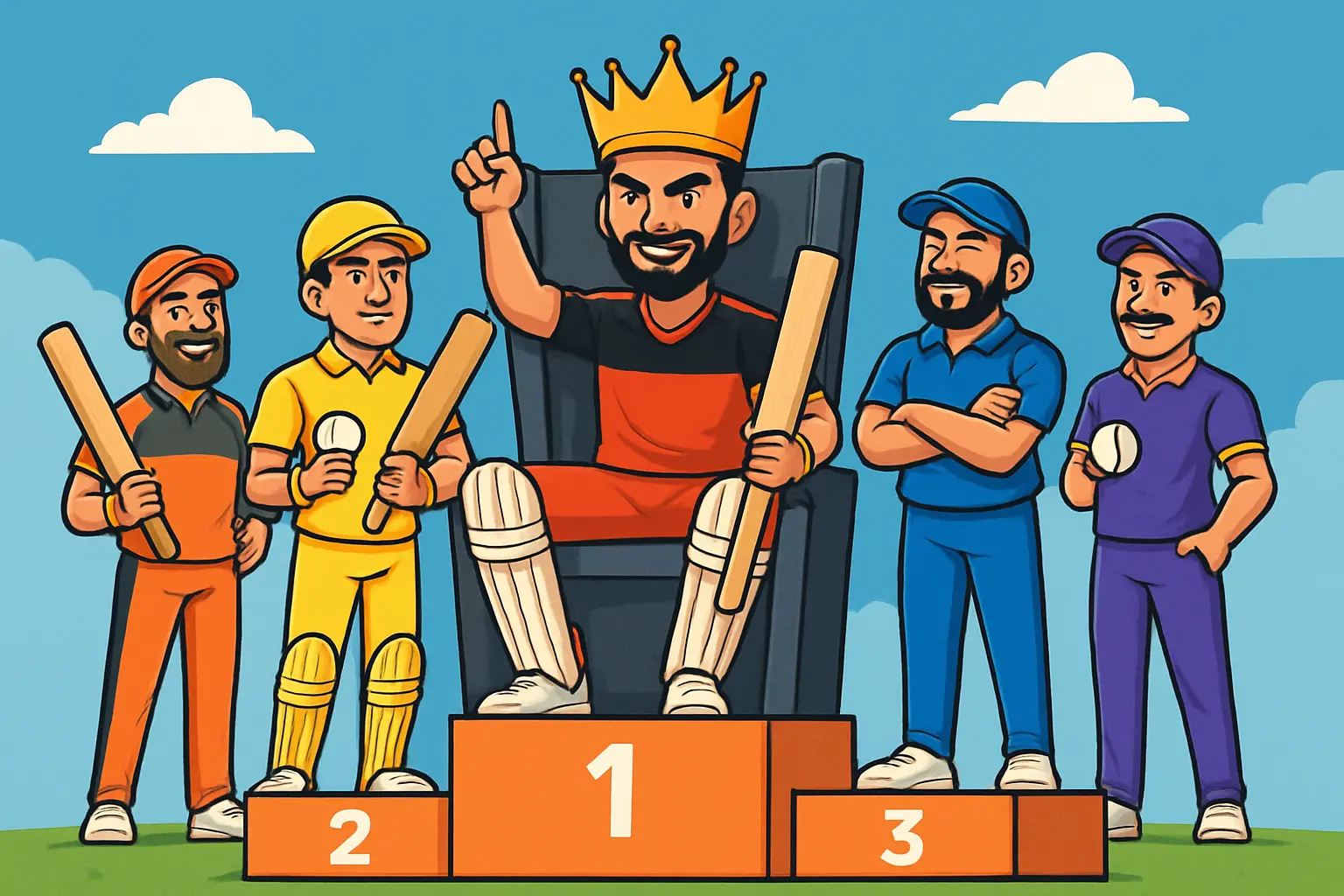
- If you want one undisputed crown across the totality of the league’s story and what defines it, you can’t escape a two-name answer: Virat Kohli for the bat; MS Dhoni for the throne. The rest of us live between those poles.
That’s the headline. The truth, of course, is richer. IPL fandom often speaks in absolutes; IPL expertise lives in nuance. “King” can mean different things—volume, consistency, strike rate, trophies, playoff impact, clutch finishing, or sheer ability to bend a chase to will. So below, I’ll define the criteria, give you a professional verdict, and then crown “kings” by category—batting, captaincy, finisher, bowling, sixes, powerplay, death overs, playoffs, finals, fielding, wicket-keeping, and more. Along the way, I’ll fold in the crucial comparisons—Kohli vs Dhoni vs Rohit—and the “GOAT/God/Mr IPL/Baap/Prince” labels that cricket culture loves.
How I define the “King of IPL”
The league rewards very specific skills. Volume scorers thrive on form cycles, surfaces, matchups, and continuity. Captains control match tempo more than most fans notice. Finishers are part grandmaster, part bouncer. Bowlers survive a batter-friendly universe by leaning on sequencing and deception. My criteria blend all of that:
- Run-scoring dominance across seasons: totals, average, strike rate, and how often big runs decide results.
- Big-match impact: playoffs, eliminators, qualifiers, finals—runs and decisions that move trophies.
- Captaincy and culture: titles, finals, but also player development, tactical clarity, and resource allocation.
- Clutch finishing: death overs with bat; ability to make targets feel 10 runs smaller.
- Consistency: good on flat decks and two-paced ones; against pace and spin; home and away; across rule changes.
- Longevity and reinvention: how players evolved—backfoot vs pace trends, spin matchups, death-hitting mechanics.
- Player of the Match stack: repeat game-breakers.
- Specialist “kingdoms”: powerplay, death overs (bat and ball), six-hitting, fielding, wicket-keeping, and bowling totals.
Quick verdict table (who leads what)
- Overall batting king: Virat Kohli — all-time leading run-scorer, multiple Orange Caps, 973-run peak season, and a late-career strike-rate reset.
- Captaincy king: MS Dhoni — record finals, record playoffs consistency, joint-most titles, unmatched wicket-keeping leadership.
- Trophy-maximizer captain: Rohit Sharma — joint-most titles; ruthless transition management; targeted use of matchups.
- Mr. IPL: Suresh Raina — playoffs runs leader, unmatched ring-fielding prime, year-on-year consistency in the league’s early heart.
- King of sixes: Chris Gayle — the original storm; six-hitting record that still towers.
- King of chases: AB de Villiers — impossible equations solved; most Player of the Match awards; quality of impact over sheer volume.
- Wickets king: Yuzvendra Chahal — first to 200 wickets, longevity without home conditions crutch.
- Death-bowling king: Lasith Malinga (legacy) and Jasprit Bumrah (modern perfection) — yorker schools, opposite-arm angles, and surgical bravery.
- Finisher king: MS Dhoni — finishing is not just hitting; it’s reading a chase with a watchmaker’s patience. Others have had explosive peaks; nobody has sustained a finishing aura longer.
- Powerplay batting king: David Warner (era-spanning sample) with current-gen disruptors like Shubman Gill and left-right pairs pushing the template.
- Fielding king: Ravindra Jadeja (impact) and Suresh Raina (catches leadership) — different flavors of outfield brilliance, both era-defining.
- Wicket-keeping king: MS Dhoni — dismissals, lightning hands, guiding spinners, and a stamp that intimidated non-strikers.
The numbers that anchor the crowns
Note: figures referenced below are up to the latest completed season. Some are rounded to keep the focus on ranking and impact rather than decimal precision.
All-time batting pillars
- Most runs: Virat Kohli (8000+)
- Chase magnets and long-haul scorers behind: Shikhar Dhawan (6600+), Rohit Sharma (6500+), David Warner (6500+), Suresh Raina (5500+)
- Most centuries: Virat Kohli (8), Jos Buttler (8), Chris Gayle (6), KL Rahul (4), David Warner (4)
- Most Player of the Match awards: AB de Villiers (record), followed by Chris Gayle and a cluster of Indian anchors and captains
All-time bowling pillars
- Most wickets: Yuzvendra Chahal (200+), Dwayne Bravo (180+), Piyush Chawla (180+), Bhuvneshwar Kumar (170+), Ravichandran Ashwin (170+)
- Death overs economy with sustained excellence: Jasprit Bumrah (benchmark), Lasith Malinga (legacy reference), and a rotating cast of specialists who caught fire in shorter bursts
All-time six-hitting
- Most sixes: Chris Gayle (350+), then Rohit Sharma, AB de Villiers, MS Dhoni, and Virat Kohli in the 250+ region
Captaincy ledger
- Titles as captain: Rohit Sharma (5), MS Dhoni (5)
- Finals as captain: MS Dhoni (record)
- Playoffs appearances as captain: MS Dhoni (record territory), Rohit Sharma (elite band)
- Wicket-keeping dismissals: MS Dhoni (most)
What “King of IPL” really means—and why Virat Kohli headlines it
Virat Kohli is called “King” for reasons that go beyond a nickname. He scaled the league’s Everest—an almost surreal 973-run season—then circled the mountain again later in his career when bowlers became smarter and teams began hunting him with specific plans. The adjustment? A more violent trigger for the powerplay, earlier access to lofted drives, a sharper eye for mid-innings acceleration, and selective brutality against pace when he has the matchup. He added a second Orange Cap deep into his IPL journey. That isn’t common. It is the hallmark of someone who understands that modern T20 batting is an arms race against analysts, footage, and databases tracking your every option.
What sets Kohli apart:
- Scale and duration: First to 8000+ IPL runs, with end-to-end production across phases and rule changes.
- Peak season that may never be matched: The 973-run outlier is cricket’s equivalent of a sprinter clocking a time that bends the sport’s curve.
- Adaptive batting model: Evolved from “anchor with a last-overs assault” to “phase accelerator” who takes more early risks and still controls innings definition.
- Big-stage temperament: While AB de Villiers often closed, Kohli set tables and paced high-pressure chases with unteachable calm.
Why MS Dhoni owns the captaincy crown
If you shifted this argument to a boardroom, the charts would belong to Dhoni. The man made more finals than some franchises changed overseas combinations. The team in yellow under Dhoni had an identity: targeted auctions, a pre-decided core, an elastic finishing strategy, and a bowling plan that accepted damage in certain phases to strangle in others. He didn’t just captain; he ran a “way of playing.” Combine joint-most titles with a record tally of finals, and you get something close to dynastic authority.
Dhoni’s strengths beyond the numbers:
- Reading rhythm: Knows when a game will be decided—in the sixth over of a chase, not the last; in the thirteenth over of a chase, not the nineteenth.
- Spinner stewardship: Makes good spinners great. He gives them fields that sell illusions and lines that prey on habits.
- Wicket-keeping as leadership: He doesn’t just take catches; he edits the game in real time with one-liners that unlock bowlers’ confidence.
- Finishing: Built a finishing identity that made bowlers panic before the equation actually favored him. That is aura, weaponized.
Rohit Sharma’s claim—and why it’s real
Rohit as captain is about tournament mastery: peaking late, using matchups surgically, and stripping emotion out of selection. He managed transitions during high-pressure eras, coaxed local quicks into becoming white-ball artists, and won titles without always owning the league stage in the table round. As a batter, Rohit’s IPL story isn’t as high-volume as Kohli’s, but his peak seasons intersected with trophies. And his pull shot under lights remains one of the IPL’s most devastating single strokes.
AB de Villiers, Chris Gayle, Suresh Raina: the other pillars of the throne room
AB de Villiers:
The chase’s artist. He won matches that were, by logic, unwinnable. In Bengaluru, he turned impossible asking rates into highlight reels, often skipping a settling-in period entirely. Most Player of the Match awards tell you coaches knew: if AB fired, you were done.
Chris Gayle:
The original rule-breaker. Powerplay fields looked like suggestions when Gayle was in. He’d change bat speed, pick up length earlier than anyone, and hit sixes that made boundary riders irrelevant. Records agree—he still sits atop sixes mountain.
Suresh Raina (Mr IPL):
Not everything needs a spreadsheet. Raina is the league’s heartbeat from its early core. Floated between three and four, bossed playoffs, owned the covers in the ring, and rarely had two bad games in a row. He should be on your first all-time XI team sheet for vibe and value.
The “Category Kings” of IPL
Batting: The King of IPL Batting
- Winner: Virat Kohli
- Why: Highest run aggregate, 50+ fifties, 8 centuries, wins an Orange Cap in different career phases, and finishes chases without theater.
- Chasing rivals: Rohit Sharma (quality runs across trophy cycles), David Warner (elite powerplay engine, multiple Orange Caps), Jos Buttler (centuries leader bracket), AB de Villiers (impact-weighted value beyond volume), Suresh Raina (playoffs bank), Shubman Gill and Suryakumar Yadav (modern strike-rate practitioners with precision scoring windows).
Captaincy: The King of IPL Captaincy
- Winner: MS Dhoni
- Why: Record finals, playoffs consistency, joint-most titles, brand of cricket installed across seasons, spinner alchemy, death-over calm, read-the-game genius.
- Rival with a claim: Rohit Sharma (joint-most titles), builds campaigns that peak on cue, fearless in making hard selection calls.
Finishing: The King of IPL Finisher
- Winner: MS Dhoni
- Why: Finishing equals control plus timing. Dhoni’s ledger isn’t just about strike rate; it’s about never letting equations balloon beyond his range and carrying tailenders.
- Rivals who entered the hall: Kieron Pollard (match-killing long-hitters’ manual), Dinesh Karthik (reinvented death-overs craftsman), Andre Russell (over-by-over demolition), Hardik Pandya (range-hitting with low launch delay).
Sixes: The King of IPL Sixes
- Winner: Chris Gayle
- Why: Most sixes by a considerable margin, longest sixes, and the aura that changed how teams negotiated powerplays.
- Rivals: Rohit Sharma, AB de Villiers, MS Dhoni, Virat Kohli—big cumulative sixers, but none close to Gayle’s peak gravitational pull.
Powerplay: The King of IPL Powerplay
- Winner: David Warner (era consistency)
- Why: Roars out of the blocks season after season, understands risk-sharing with partners, and targets his matchups early.
- Modern template disruptors: Shubman Gill’s risk-managed acceleration; left-right combinations featuring explosive left-handers who drive at 140+ strike rates from ball one; openers like Travis Head reshaping playbooks by attacking hard lengths over midwicket fences.
Death Overs (Batting): The King of IPL Death Overs Batting
- Winner: Andre Russell (peak destruction) and MS Dhoni (endgame control)
- Why: Russell averages a boundary nearly every second ball in dream seasons. Dhoni slows chaos; his finishing includes the intangible—your bowler’s heartbeat.
- Rivals: Dinesh Karthik (late-innings revivalist), Kieron Pollard (towering ball-striker), Hardik Pandya (seam-up lofting with a fast bat path).
Death Overs (Bowling): The King of IPL Death Overs Bowling
- Legacy winner: Lasith Malinga
- Modern benchmark: Jasprit Bumrah
- Why: Both nail yorkers at will, both unpredictable in sequence, and both brave enough to miss by an inch if it buys three dot balls around it.
Bowling: The King of IPL Bowling (Wickets)
- Winner: Yuzvendra Chahal
- Why: First to 200 wickets in a league where wrist spin lives and dies by subtlety, and where batters now sit deep waiting for error. He still finds the error.
- Rivals: Dwayne Bravo (complete T20 seam package), Piyush Chawla (renaissance story), Bhuvneshwar Kumar (powerplay master with late-overs poise), Rashid Khan (the leggie batters plan months for).
Fielding: The King of IPL Fielding
- Winner: Ravindra Jadeja (impact) and Suresh Raina (catches record)
- Why: Jadeja closes singles like a goalkeeper; his direct hits swing games. Raina’s hands and reading of angles in the ring won countless pressure overs.
- Rivals: Kieron Pollard (boundary king), AB de Villiers (total athlete), Faf du Plessis (laser catching), Hardik Pandya (dynamic in-ring mover).
Playoffs: The King of IPL Playoffs
- Winner: Suresh Raina
- Why: Most playoff runs, tempo-setting knocks when fresh ball and nerves dominate.
- Rival aura: MS Dhoni (captaincy and finishing presence), Rohit Sharma (captaincy with timely knocks), Rashid Khan (spin-control in pressure), Kieron Pollard (a couple of finals-altering bursts), Lasith Malinga (a title sealed with one ball).
Finals: The King of IPL Finals
- Winner: MS Dhoni (captaincy), Rohit Sharma (titles), Lasith Malinga (one-over legacy), and a few singular batting nights that live forever.
- Why: Finals are often decided by calm decisions made 15 overs earlier—the two captains above are peerless there. And in a certain finale, Malinga bowled the last over that victory stories are made of.
Wicket-keeping: The King of IPL Wicket-Keeping
- Winner: MS Dhoni
- Why: Most dismissals, best “gloves-to-brain” captaincy relay, and game-speed beyond the cameras’ rest.
Comparison table: Kohli vs Dhoni vs Rohit (plus AB and Raina)
| Player | Primary crown | Batting hallmark | Leadership/trophies | Playoff/Finals impact | X-factor |
|---|---|---|---|---|---|
| Virat Kohli | King of IPL batting | 8000+ runs, 8 tons, anchor-to-accelerator evolution | N/A (as captain legacy in IPL is limited) | Sets up chases, tempo control | Relentless consistency; aura |
| MS Dhoni | King of IPL captaincy and finishing | 5000+ runs, elite finishing IQ | Joint-most titles; record finals | Finisher presence and decisions | Wicket-keeping brain trust |
| Rohit Sharma | Trophy-maximizing captain | 6500+ runs, opening recalibration | Joint-most titles | Timely big knocks; steady endgame reads | Matchup-driven template building |
| AB de Villiers | King of chase impact; PoTM leader | 5000+ runs, 150+ strike rate curve | N/A | Insane chases in Bengaluru | Reinvents par score mid-chase |
| Suresh Raina | Mr IPL | 5500+ runs, playoffs runs leader | N/A | Knock-on-demand in knockouts | Fielding plus batting elasticity |
A deeper, more human read on the crown debates
Why is Virat called the King of IPL?
- He wins the long game: Kohli’s career in the league is a graph of phases—young baseliner, peak accumulator, and now an aggressive opener with tools he didn’t lean on earlier. That’s not just talent; it’s coaching himself into a new version when bowlers learned the old one.
- He places high value on singles in an economy of boundaries: It’s a chronic undervaluation—Kohli’s smartest games are where he denies dot-balls between boundaries. That is still the cleanest way to beat the IPL middle overs.
- He solved spin early: Lofts over extra cover, late sweeps, and a method against wrist spin that puts square leg in play without losing his off-side identity.
Dhoni vs Rohit: who is the real captaincy king?
- Dhoni is the culture king. No captain in the league’s history has authored such a consistent template: a pre-decided core, clarity in roles, a non-panic approach when starts are cold, and a finishing structure that makes ordinary totals feel defendable.
- Rohit is the campaign optimizer. He’s ruthless with resources, daring in switching roles mid-season, and unsentimental with reputations. He helps rookie quicks find a limited yet lethal plan. Hard decisions won titles.
AB de Villiers vs Kohli: who owned chases?
- Kohli is the surgeon; AB is the storm. Kohli roots himself in the chase equation early and chokes the match until the chase is a formality. AB ignores the equation’s politeness; he flips it with a two-over burst that breaks the spreadsheet.
Gayle vs the rest: can anyone touch the sixes crown?
- Unlikely. Gayle’s lead is large, and he built it during an era where fielding innovation and data weren’t at today’s levels. Others have approached modern six-volume with improved strike rates, but the distance from Gayle remains intact.
The stats tables that matter (leaders, without overcooking the numbers)
All-time leaders snapshot (latest completed season)
- Most runs: Virat Kohli (8000+)
- Most centuries: Virat Kohli (8) and Jos Buttler (8)
- Most fifties: Virat Kohli leads the cluster of Dhawan/Warner/Rohit
- Highest strike rates (1000+ runs): Andre Russell tops the class; Glenn Maxwell and Suryakumar Yadav in the elite band
- Most sixes: Chris Gayle (350+)
- Most player of the match awards: AB de Villiers (record)
- Most wickets: Yuzvendra Chahal (200+)
- Most titles as captain: Rohit Sharma (5), MS Dhoni (5)
- Most finals as captain: MS Dhoni (record)
- Most playoffs runs: Suresh Raina (leader)
- Most wicket-keeping dismissals: MS Dhoni (leader)
- Orange Cap multiplicity: David Warner (most), Virat Kohli and Chris Gayle close behind
The “why” behind the numbers: tactics and micro-stories only insiders notice
- Dhoni’s spin nets: Watch how he sets a square leg that hovers between catching and saving one, pulling the batter into a chest move that leaves the wrong-on to trap the sweep. Fielding angles under him aren’t decoration; they are chess pieces.
- Rohit’s powerplay trap: He’ll tolerate sixes early if it buys him two overs at a favorable angle for his enforcer. Most fans call it luck when the wicket falls. It was a funnel all along.
- Kohli’s cover drill: The signature extra-cover loft isn’t just elegance; it’s a pressure release valve against left-arm spin and a template for beating the two-man leg-side trap that many teams set.
- AB’s “middle of the bat”: When AB moves across off-stump, it’s not always to scoop. He often wants a fuller length to open midwicket and long-on. Miss short and he slices you over point with top-hand control.
- Gayle’s “stand and deliver”: Bowlers learned over time that full wide lines slow him down. He answered by playing with lighter bat pick-up earlier in innings or waiting a ball longer. The ability to adjust bat speed late in career is underrated.
- Bumrah’s slow ball: The change-up doesn’t need heavy backspin if the batter is primed for the yorker. It only needs to look like the yorker hand at release. Batters load early, mis-hit into the wind.
Team-wise “kings”
King of CSK in IPL:
MS Dhoni. With Jadeja as the fielding and all-round glue; Raina as Mr IPL and playoffs bank.
King of MI in IPL:
Rohit Sharma as the captaincy brain; Jasprit Bumrah as enforcer-architect; Kieron Pollard as the finisher who iced multiple trophies.
King of RCB in IPL:
Virat Kohli. AB de Villiers as co-architect of chases, and now Faf du Plessis as culture custodian with attacking alignments.
King of KKR in IPL:
Gautam Gambhir’s captaincy era forged the identity; Sunil Narine has been the system’s superpower; Andre Russell as the hammer that turns par into panic.
King of SRH in IPL:
David Warner’s run-scoring kept the engine running for years; Bhuvneshwar Kumar’s powerplay skills and Rashid Khan’s mid-overs choke were foundational.
King of RR in IPL:
Sanju Samson’s batting leadership, Jos Buttler’s purple patches, and an origin story anchored by Shane Watson’s early all-round influence.
GOAT of IPL:
A two-horse debate—MS Dhoni (captaincy + finishing + legacy, unmatched finals record) vs Virat Kohli (batting mountain, multi-era Orange Cap champion, 973-run apogee). If “GOAT” privileges trophies and leadership, lean Dhoni. If it privileges run-scored mastery sustained across the league’s lifetime, lean Kohli.
God of IPL:
Fans often use this for Dhoni because of his cult finishing nights and the calm he projects.
Mr IPL:
Suresh Raina. It isn’t close when you blend playoffs runs with ring fielding, flexible batting roles, and personality.
Baap of IPL:
In common parlance, often thrown Dhoni’s way for the captaincy aura or Rohit’s for titles. In a six-hitting conversation, some will cheekily hand it to Gayle.
Prince of IPL:
A moniker fans attach to young or graceful high-ceiling batters—Shubman Gill often attracts it for the high-class powerplay acceleration with minimal visible effort.
Fresh-season context without spoilers
Even as team roles change, leaderboards and legacies are remarkably stable. Kohli’s run mountain widened. Dhoni’s finals and dismissals record strengthened. Chahal broke into the 200-wicket club. Modern openers attacking from ball one have redefined the powerplay calculus, with left-handers opening up midwicket pockets that older templates did not target as early. The death overs remain a laboratory: slow-ball varieties, cross-seam grip changes, and longer boundaries on one side of some venues keep the contest from becoming a slog-a-thon.
What about “consistency kings”?
Consistency isn’t just average. It’s the ability to produce a usable innings more often than not in volatile conditions.
Consistency kings
- Virat Kohli: The most reliable 30+ runs-to-games ratio across a very large sample.
- Suresh Raina: Minimal slumps in prime years; playoffs consistency is unmatched.
- David Warner: Year-on-year 400+ seasons stacked; powerplay output rarely goes missing.
- MS Dhoni: Doesn’t chase averages; chases moments. As a finisher, consistency lives in the number of games you “win or extend.” He did that endlessly.
- Rashid Khan: With ball, his 4 overs almost always balance a lineup, even without wickets.
Strike-rate kings (min 1000 runs, role-adjusted)
- Andre Russell sits atop. He’s a boundary event waiting to happen, with high launch and a short wait time to access power.
- Suryakumar Yadav is an angle manipulator—his 360-degree intent around the 45s compresses fields and ruins good plans.
- Glenn Maxwell at his best plays as if the boundary is 2 meters closer for him alone.
FAQs (expert answers, crisp and direct)
Who is the King of IPL?
Virat Kohli is widely regarded as the King of IPL for batting dominance, career-long volume, and peak seasons that redefined the ceiling. MS Dhoni is the King of IPL captaincy and finishing. If forced to pick one name, most will say Kohli for “King,” and still acknowledge Dhoni’s captaincy crown.
Why is Virat called King of IPL?
Highest run tally, multiple Orange Caps in different career phases, a 973-run peak season, elite chase temperament, and recent strike-rate modernization to match newer powerplay trends.
Who is the true King of IPL captaincy?
MS Dhoni. Record finals, playoffs consistency, and joint-most titles. He didn’t just win; he built a system.
Who is Mr IPL and why?
Suresh Raina. Playoffs runs leader, unmatched ring-fielding prime, versatility at three and four, and an aura that defined the league’s heartbeat in its formative seasons.
Who is the King of IPL playoffs?
Suresh Raina for batting; MS Dhoni for finishing aura and captaincy; Lasith Malinga and Jasprit Bumrah for death-bowling clarity.
Who is the King of IPL finals?
MS Dhoni (captain), Rohit Sharma (championship cycles), Lasith Malinga (one-over immortality), and several hitters with singular nights. Finals reward early decisions; Dhoni and Rohit made them better than most.
Who is the King of IPL powerplay?
David Warner for era-spanning consistency. Among current trendsetters, left-hand openers and precise right-hand anchors with early loft access are reshaping the first six overs.
Who is the King of IPL death overs batting?
Andre Russell for peak destruction; MS Dhoni for endgame control that turns panic into poise.
Who is the King of IPL bowling?
For wickets: Yuzvendra Chahal. For death bowling: Lasith Malinga (legacy) and Jasprit Bumrah (modern standard).
Who is the King of IPL sixes?
Chris Gayle, comfortably.
Who is the King of CSK in IPL?
MS Dhoni. With Jadeja and Raina as the immortal lieutenants.
Who is the King of MI in IPL?
Rohit Sharma for captaincy, Jasprit Bumrah for bowling impact, Kieron Pollard for finishing.
Who is the King of RCB in IPL?
Virat Kohli. AB de Villiers as the chase co-architect.
Is Rohit Sharma the King of IPL captaincy?
He is joint-most in titles and a peerless campaign finisher. But the crown for overall captaincy legacy still sits on MS Dhoni.
Who is the GOAT of IPL?
The split answer: Dhoni (captaincy and finishing legacy) versus Kohli (run mountain and longevity at the top). Choose your metric; either is defensible.
Who is the God of IPL?
Popular culture gives it to MS Dhoni due to aura and finishing folklore.
Who is the Baap of IPL?
Often slang for dominance in a category—Dhoni for captaincy, Rohit for titles run, Gayle for sixes.
King-of-IPL comparisons you ask your friends to settle
Virat vs Dhoni: who is the King?
Kohli if you’re crowning on batting supremacy and innings value; Dhoni if you’re crowning on captaincy and finishing. In truth, one defines the run-chase script; the other defines the trophy’s journey.
Dhoni vs Rohit: best IPL captain?
Dhoni for culture and finals gravitation; Rohit for campaign peaking and ring management. Two styles, equal silverware.
Kohli vs Rohit: IPL records?
Kohli owns the volume mountain—runs, centuries cluster, Orange Caps. Rohit owns the rings—captaincy titles, late-season surges.
How the latest season reshaped nothing and everything
- Kohli’s acceleration up top reminded everyone that great players don’t cling to old versions of themselves.
- Chahal crossed a sacred bowling milestone that matters even more in this league than in longer formats; it says he kept reading batters while they were reading him.
- Modern openers took powerplay intent to new levels, forcing better teams to reallocate overs and bias the back end with different matchup plans.
- Death overs remained a specialist’s pride, with Bumrah proving again that even in a six-happy league, a single over can tilt the axis.
Tactical mini-guides (for those who like the nerdy stuff)
Bowling to Kohli in the powerplay:
- Don’t get greedy full on off-stump early; his hands are too fast through cover. Make him fetch from outside his hitting arc and vary angles into the hip to disrupt the front-foot press.
Bowling to Dhoni at the death:
- No predictable full lengths when he’s set. Work the back-of-a-length zone, rollers into the pitch, and never feed the wide yorker twice in a row—he loads the bat face for the carve.
Bowling to AB de Villiers late:
- Show him different fields for the same ball in consecutive deliveries. He’s too quick if he can read the defender’s movement. Mix above-eye-line bouncers with dipping wide full balls, never in a pattern.
Batting against Bumrah:
- Commit to length read early. Don’t chase the yorker with a stretch; he wants you to. Instead, pre-meditate zones—deep in the crease for cutters, step across to open leg-side to get him to miss stump lines.
Chasing flowchart:
- Treat the ninth to twelfth overs like a second powerplay. That’s where most chases drift. Hit one boundary an over; don’t aim for hero overs until you have a matchup bowler.
Regional quick answers (for fans searching in their language)
- आईपीएल का किंग कौन है: बल्लेबाज़ी में विराट कोहली, कप्तानी और फिनिशिंग में एमएस धोनी।
- ipl ka king kaun hai: batting mein Virat Kohli; captaincy aur finishing mein MS Dhoni.
- ஐபிஎல் கிங் யார்: பேட்டிங் – விராட் கோலி; கேப்டன்சி & பினிஷிங் – எம். எஸ். தோனி.
- আইপিএল-এর কিং কে: ব্যাটিংয়ে বিরাট কোহলি; ক্যাপ্টেন্সি ও ফিনিশিংয়ে এমএস ধোনি।
- “King of IPL batting: Kohli’s mountain. King of IPL captaincy: Dhoni’s throne.”
- “Gayle changed physics; AB de Villiers changed math.”
- “If the chase has a pulse, Dhoni has a plan.”
- “Bumrah at the death is not an over; it’s a verdict.”
A living leaderboard mindset for the next season
Crowns in this league are argued more than they are awarded. That’s part of the joy. Even so, some truths feel settled:
- Kohli’s run ledger is the Himalaya everyone else shoots.
- Dhoni’s captaincy and finishing identity is the league’s compass.
- Rohit’s trophy profile is a monument to timing and matchups.
- Chahal’s wicket tally tells you wrist spin still wins.
- Gayle’s six record frames what power-hitting means.
- Raina’s “Mr IPL” tag is the soul of the league’s formative heartbeat.
- AB de Villiers’ chase tapes remain the film schools of T20 batting.
Final word
If you want one name for the King of IPL, take Virat Kohli. If you want the captain of kings, take MS Dhoni. And if you want to understand why this league became a season-long epic rather than a fortnight fling, study the way these two—and their closest rivals—taught everyone else to play.
Category crowns will keep shuffling around the edges. The core won’t. The league’s greatest stories were written by a handful of players who did more than fill scorecards; they altered how the game is played and how it is felt. That is what a king does.
Zahir, the prolific author behind the cricket match predictions blog on our article site, is a seasoned cricket enthusiast and a seasoned sports analyst with an unwavering passion for the game. With a deep understanding of cricketing statistics, player dynamics, and match strategies, Zahir has honed his expertise over years of following the sport closely.
His insightful articles are not only a testament to his knowledge but also a valuable resource for cricket fans and bettors seeking informed predictions and analysis. Zahir’s commitment to delivering accurate forecasts and engaging content makes him an indispensable contributor to our platform, keeping readers well informed and entertained throughout the cricketing season.