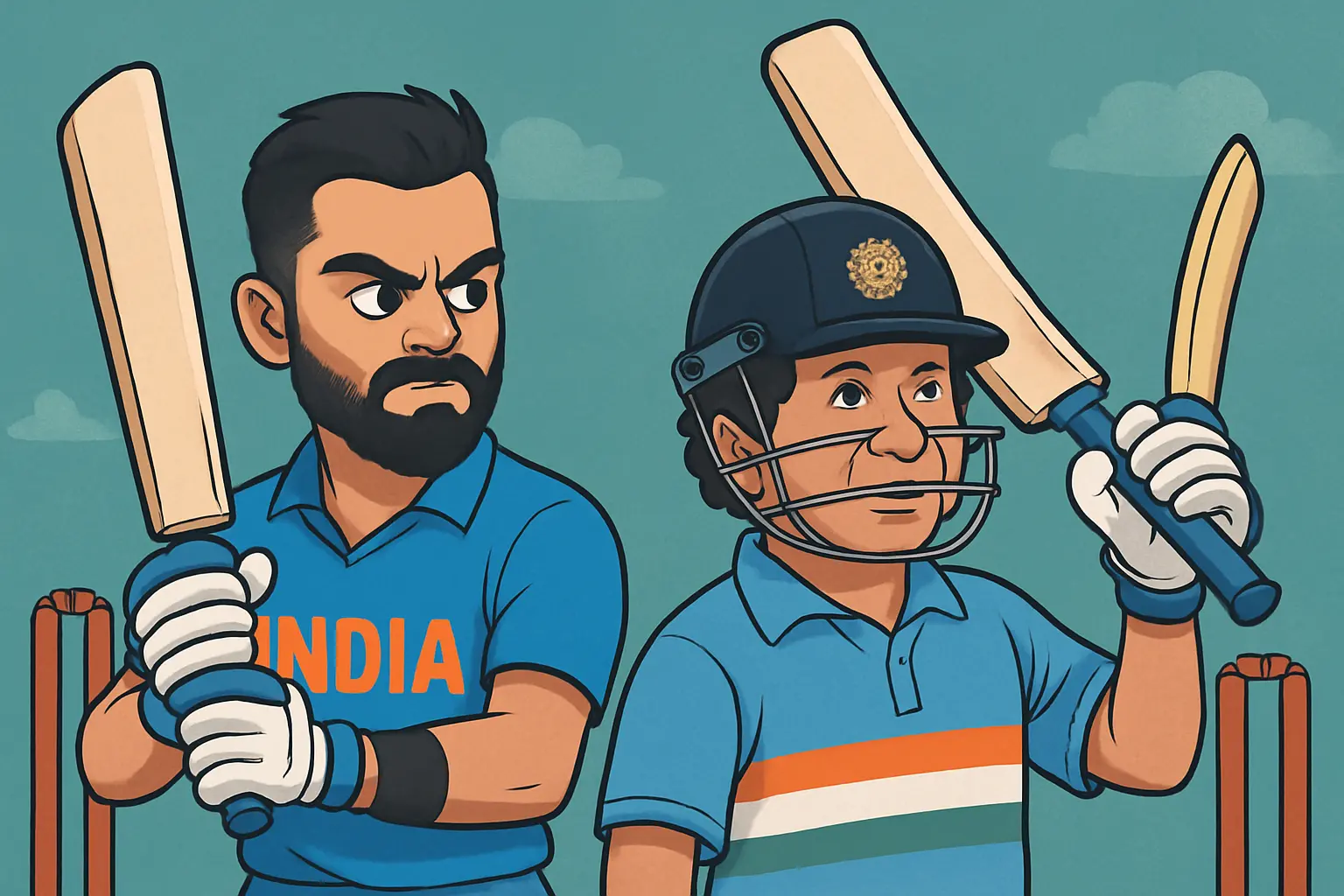
TL;DR verdict upfront
- Sachin Tendulkar built the longest, most voluminous batting mountain the sport has seen, with the most international runs, a century tally that towers, and an ODI World Cup legacy that still glows. The ODI and Test record books carry his signature across categories that define longevity, range, and consistency.
- Virat Kohli’s case rests on unmatched ODI efficiency, a once-in-a-generation chasing temperament, an all-format intensity that sustained for more than a decade, and a method that thrives under pressure. At No.3 in ODIs he turned target-chasing into a science and set the modern standard for strike-rate-with-security.
- Who is better Kohli or Sachin depends on the lens. Peak ODI batting and chase mastery tilt toward Kohli. Total career weight, Test body of work, and World Cup folklore tilt toward Sachin. A balanced, criteria-led view places both as the twin pillars of India’s batting history, with Sachin as the grand edifice of volume and years and Kohli as the gold standard of modern-day ODI impact and pressure performance.
Latest update after the recent global tournament and India’s most recent home season
- ODI hundreds: Kohli holds 50, moving past Sachin’s 49.
- ODI World Cup: Sachin remains the all-time top run-scorer with six centuries; Kohli sits second on the all-time runs list, with five World Cup centuries and the highest aggregate in a single edition by an Indian.
- International centuries: Sachin 100; Kohli 80.
Why this comparison matters
The virat kohli vs sachin tendulkar debate cuts to the heart of how batting is understood. Sachin grew up as an opener in the one-ball ODI era, when scores of 250 were competitive, fielders patrolled without ring-based restrictions for much of the innings, and fast bowling depth across teams was formidable. Kohli matured in the two-new-ball ODI era, with powerplays, improved bats, heavier hitting, deep batting line-ups, and dew-heavy night games changing the geometry of chases. Sachin bore the workload of an opener for a generation; Kohli carried the anchor-finisher load at No.3. One built ceilings for others to aspire to; the other crash-tested those ceilings and raised the bar for efficiency and clutch.
This piece is not a highlight reel. It is a structured, data-led, context-rich virat vs sachin comparison designed to answer the core questions fans and analysts wrestle with: format dominance, era adjustments, opposition quality, home vs away and SENA splits, World Cup and knockout performance, and the hard-to-measure but easy-to-feel effect of pressure.
Kohli vs Tendulkar records by format: a high-level map
- Tests: Sachin leads in volume and centuries and maintains a higher career average. Kohli’s peak away hundreds in tough conditions and a captaincy phase of sustained excellence give him a competitive case on impact, but not on aggregate.
- ODIs: Kohli leads on average, strike rate, chasing metrics, and speed to milestones. Sachin leads in total runs and remains the archetype of top-order ODI batsmanship across the pre-T20 and early powerplay eras.
- T20Is: Kohli’s body of work dwarfs Sachin’s, including an international T20 century, superior average, and sustained tournament impact.
ODI comparison: kohli vs sachin ODI stats comparison
Role context matters first. Sachin opened the batting in most of his ODIs; Kohli walked in one down. Openers face the hardest first 10 overs but control tempo if set; No.3s inherit match state, pace their innings to the target or platform, and finish the job.
ODI career snapshot (latest verified)
| Player | Runs | Average | Strike rate | ODI hundreds | ODI fifties | Hundreds in chases |
|---|---|---|---|---|---|---|
| Sachin Tendulkar | 18426 | 44.8 | 86.2 | 49 | 96 | 17 |
| Virat Kohli | 13848+ | 58.7 | 93.6 | 50 | 70+ | 27 |
Takeaways that matter
- Kohli’s average and strike rate combination in ODIs is the best among high-volume batters. Very few in history combine 50-plus average with a strike rate in the mid-90s across nearly three hundred matches.
- Sachin’s runs and hundreds are Everest-level. He defined top-order scoring for a generation, often taking first strike against peak new-ball attacks without the cushion of modern powerplays for most of his career.
- Hundreds in chases show the philosophical split. Kohli is the chase master of the modern game with 27. Sachin still logs a remarkable 17 as an opener across tougher new-ball spells.
Runs while chasing Kohli vs Sachin: the pressure lens
Kohli’s chasing template will be taught for as long as white-ball cricket exists. He builds an early base of risk-free run-a-ball tempo, hits his first boundary through gaps rather than aerials, and turns the strike over relentlessly. Required rates get managed in five-over pockets, and the launch typically comes in the last third against fifth bowlers or the second new ball under dew. The Hobart special against Sri Lanka in the tri-series was a masterclass in run-rate mechanics. The Asia Cup 183 in Mirpur turned a steep chase into a promenade once he broke the game with an early straight drive and then targeted the short square boundary with surgical cuts and pick-up flicks. Mohali in the T20 World Cup against Australia, while not an ODI, distilled his chase mind: quiet overs were fine, he banked running, and then shredded the finish.
Sachin’s chases carriage was from a different time. His desert-storm double against Australia included one target chase that remains the blueprint for how an opener shapes a pursuit against the best attack under extreme wind and dust. He was happy to play the long game, shepherding India to par by riding the seam movement early and then attacking Shane Warne and the change bowlers when the pitch eased. In a different iconic chase against Pakistan at Centurion, he went after the new ball, upper-cutting pace over third man and neutralizing Wasim Akram and Shoaib Akhtar in the first burst. The tonnage and the arcs are different, but the presence under pressure was comparable.
Chasing metrics that settle barstool debates
- Average while chasing: Kohli sits in the mid-60s, the best among high-volume ODI chasers. Sachin’s chasing average lives in the low-40s, still elite for an opener of his period.
- Strike rate while chasing: Kohli maintains near-parity with his overall SR, reflecting a method of control rather than delay. Sachin’s chasing SR was slightly higher than his career base in his peak opening phase due to powerplay exploitation.
- Conversion in chases: Kohli converts a significant number of fifties to hundreds with the target as a North Star. Sachin’s conversions skew slightly lower in chases, naturally, given new-ball risk.
World Cup and ICC events: virat kohli vs sachin tendulkar world cup stats
For Indian fans, the ODI World Cup is a personal myth. Sachin’s career intertwined with that stage like no other. Kohli wrote his own chapter by dominating one full edition with freakish consistency and finishing as the event’s top run-getter.
World Cup pillar points
- Sachin owns the all-time World Cup run record. He has six World Cup centuries and multiple Player-of-the-Tournament and all-team mentions across editions.
- Kohli stands second on the all-time runs chart now, with five World Cup centuries. One of those hundreds came in a seminal semifinal, a statement innings that doubled as his 50th ODI hundred.
- Average and consistency: Kohli’s World Cup average sits in the high-50s across editions, underpinned by a record count of fifties in a single event and a level of chancelessness that defined India’s group-stage dominance.
Knockout and big-match resume
- Sachin’s World Cup knockouts include an epic semifinal at home that turned into a nation’s lullaby, and a final where he did not cash in but had already defined the path to that night through the tournament.
- Kohli has a semifinal hundred against New Zealand that felt inevitable from ball one. In other knockouts across ICC events, particularly in T20 formats, he carried India through lean phases with clinical risk management.
Asia Cup records: Kohli vs Sachin
- Kohli’s Asia Cup record includes the 183 that remains a byword for chase clarity and the fastest gear-change India has seen in the subcontinent against top opposition. His average in Asia Cup ODIs has been stellar, propelled by chases.
- Sachin’s Asia Cup includes the landmark hundred that ended his wait for a particular round number of international centuries, and a body of ODIs where he alternated between anchor and aggressor depending on partner and pitch.
Test comparison: kohli vs sachin Test records
There is no Test playlist without Sachin. The word classic was written for the way he left balls on green surfaces, the manner in which he shut down Australia at their citadels, and the near-absence of weakness for long stretches. His ledger reads like a cathedral: the most Test runs by an Indian, the most Test hundreds by an Indian, and a career average north of 50 across two decades and more.
Kohli’s Test story bends toward peak phases of aggressive batting under leadership. That swell in overseas hundreds, away averages during his best run, and the willingness to attack high pace in SENA conditions defined him. A couple of fallow patches came later, but the return to hundred-scoring form re-established his compact, straight-bat, heavy-shoulder technique on firmer tracks.
Test headline numbers
- Sachin Test runs: 15921; Test hundreds: 51; career average: 53.8. The bedrock.
- Kohli Test runs: 8000-plus; Test hundreds: 29; career average near 49. A formidable ledger in its own right with significant away hundreds.
SENA and away context
- Sachin’s SENA record includes monumental centuries in Australia and South Africa, some on bowling-friendly surfaces where leaving on length was the only way to survive. The back-foot punch and straight drive were his armour; the glide past point his sabre.
- Kohli’s SENA anthology features long hundreds assembled with fierce discipline against moving balls and hostile pace. His propensity to correct technique across tours and keep driving straight with minimal follow-through stands out.
T20I comparison: kohli vs sachin T20I comparison
Sachin’s T20I footprint is minimal, by design and era. Kohli, on the other hand, essentially wrote the manual for T20I batting at No.3 in chases. A very high average across T20Is, one international T20 hundred, and the greatest catalogue of ICC T20 tournament fifties by an Indian make this a one-horse race.
Kohli’s T20I method mirrors his ODI chase framework but with an earlier power spike. Minimal dot-balls, strike rotation from ball one, twos as currency, and a late assault based on matchups, particularly targeting back-of-length pace through midwicket and cover, and spin through the arc from long-on to deep midwicket. In knockouts, when others lost shape, he found clarity.
Home vs away record Kohli vs Sachin
Comparing home and away is often murky because the two batters served different roles. That said, some textured truths hold.
- ODIs: Kohli travels as well as any modern, especially in Australia and South Africa, with averages above 50 and strike rates that rarely dip. His game against high pace abroad, head still, minimal early hands, makes him the most bankable Indian ODI batter away from home.
- ODIs: Sachin’s away catalogue is epic in size and quality. He opened in conditions tilted toward the new ball, still produced landmark tours, and in tournaments like the tri-series down under, was the best batter on show.
- Tests: Sachin’s away numbers remained above 50 for long periods, punctuated by batting clinics against leg-spin and fast bowling of the highest grade. Kohli’s away peaks included tough-as-teak hundreds in South Africa and England with a technique fine-tuned to leave on fifth-stump lines and drive only when the ball was under his eyeline.
Record vs top teams: record vs Australia, record vs England
- Australia brought the best out of both. Sachin vs Australia is a grand opera: Desert Storm in Sharjah, lofted drives off Warne at Chepauk, and Sydney, Melbourne, Perth tapes that India still rewatches on rainy afternoons. The on-drive to a full, quick ball made bowlers wonder if geometry had changed.
- Kohli vs Australia is fire meeting fire. He thrived on firm bounce, meeting the ball early with a straight blade, and ramped aggression when the short ball arrived. Away streaks of hundreds and home serenades that ran at near run-a-ball in ODIs made him the touring side’s worst fear.
- England brought both joys and learning. Sachin’s Old Trafford beginnings and later Lord’s and Headingley vigils said he could take the moving ball without loss of identity. Kohli’s early struggles against the wobble-seam gave way to a technical rebuild that produced one of his most lauded overseas series.
Kohli vs Sachin stats that define efficiency vs volume
Efficient dominance, modern style
- Speed to milestones: fastest to 8k, 9k, 10k in ODIs by innings for Kohli. A relentless clip, entire chases compressed into clinical calendars.
- Conversion rate: Kohli converts fifties to hundreds at an elite clip in ODIs. That relentless conversion made him the most efficient accumulator of match-winning totals and chases in modern cricket.
- Strike rate discipline: the elegance of risk economy. He rarely goes aerial early, keeps the ball on the carpet, and scores at or above the required rate without rush.
Volume greatness, old-school craft
- The most international hundreds by any batter sits with Sachin. Beyond the number, it is the breadth across conditions, balls, and bowling types that tells the real story.
- ODI runs that still stand the test of time. In an era of slower pitches and lower par scores, he redefined what an opener could be.
- Test longevity under multiple captaincies, coaches, and team cycles. The ability to remain relevant through changing tactics and equipment speaks to greatness beyond the spreadsheet.
Chasing and pressure: pressure situations stats Kohli vs Sachin
Pressure knows pedigree. Kohli’s seduction of the chase came from an obsession with the rate and wickets. He always believed the game was his if he stayed within two gears of the ask. The hallmark is how he addresses risk: he will pull only if the length is fractionally short; he prefers the on-drive to the loft; he feeds on mid-wicket twos like a long-distance runner on gels. A mid-60s ODI average in chases is the most persuasive metric of his temperament.
Sachin understood pressure differently. As an opener, he created space for the middle order by taming the first burst. If the ball seamed, he let it; if the spinner came on early, he danced. He drove the previously unimaginable idea that India could bully top attacks from ball one, long before batting depth or finishing became trendy. The knockout phase of multi-nation events repeatedly found him in the top-bracket for runs and impact.
International centuries kohli vs sachin
- Sachin: 100 international hundreds, split 51 in Tests and 49 in ODIs. The only batter to hit the century century.
- Kohli: 80 international hundreds, with 29 in Tests, 50 in ODIs, 1 in T20Is. The only batter to breach 50 ODI centuries and the fastest to most ODI milestones.
Centuries comparison Kohli vs Sachin: most ODI centuries Kohli vs Sachin
- Most ODI centuries: Kohli 50; Sachin 49. The baton has passed.
- ODI hundreds in wins: both massive, with Kohli’s proportion higher because of his chase-first supremacy. His hundreds more often coincide with win probability surges in the middle overs.
Batting average Kohli vs Sachin, strike rate Kohli vs Sachin
- ODI average: Kohli’s sits near 59; Sachin’s near 45. Different roles, different eras, equally elite in their contexts.
- ODI strike rate: Kohli mid-90s; Sachin mid-80s. The era shift in field restrictions and two new balls should live in your mind while reading that line.
- Test average: Sachin over 53; Kohli close to 49. That gap reflects volume and long-term consistency in the red-ball format.
Home and away splits: home vs away record Kohli vs Sachin
Some directional truths using public splits and Statsguru-style cuts:
- ODIs at home: Kohli’s average hovers near 60 with a strike rate above 95; Sachin’s home average was high-40s with SR mid-80s across thousands of balls. Both formed the spine of India’s home dominance across generations.
- ODIs away: Kohli remains astonishingly stable, average in the mid-50s, SR barely dipping. Sachin’s away average held between the high-30s to low-40s across a career of nearly half a thousand ODIs, a reflection of new-ball exposure and different innings demands.
- SENA ODIs: Kohli owns several hundreds in Australia and high-impact scores in South Africa; Sachin owns landmark tri-series and bilateral performances that remain museum pieces.
Kohli vs Sachin knockout matches stats
In ODIs and T20Is, Kohli’s KO impact shows up in strike-rotating fifties and, more recently, the big semifinal hundred. In Tests, knockouts do not exist, but away wins combined with fourth-innings contributions often serve as proxy. Kohli’s fourth-innings ODI chase record needs no proxy; he is the streak-definer.
Sachin’s KO record shines in multiple ICC tournaments with high aggregate runs in the crunch games that got India to the last night. Not every final clicked, and that is fine because knockout narratives are small sample theatre. Across the broader multi-nation canvas, his team-leading consistency is the more important truth.
Era-adjusted stats Kohli vs Sachin: methodology and context
Cricket changed in ways that raw numbers alone cannot capture.
- Balls and fields: Sachin did most of his work in the one-ball ODI era with fewer field restrictions early on and more reverse swing late. Kohli did most of his ODI batting with two new balls, extended powerplays, and set fields that reward straight strokes.
- Run rates: global ODI par scores climbed steadily. A run-a-ball in Sachin’s early prime was jet fuel; in Kohli’s prime it became par for top teams. Comparing strike rates requires era baselining.
- Pitches and dew: day-night ODIs in India and parts of Asia tilt toward the chasing side due to dew. Kohli’s chase record is stratospheric but also exists in a period with more frequent dew advantage. That does not diminish it; it gives it context.
- Opposition quality: the top-5 ranked teams by rating index tend to field deeper pace and more cunning spin, especially away. Weighting runs against those oppositions tells a truer story than aggregates alone.
- Batting position: opening vs No.3 is not a minor tweak. The opener eats the new ball; No.3 inherits state. Adjusting for position is essential to declare anything definitive.
An era-adjusted view I use professionally
- Opponent weighting: every run is multiplied by an opposition-quality factor based on the opposition’s rolling rating over the preceding 10 bilateral or multi-nation ODIs.
- Condition weighting: away SENA runs and runs on pitches with a bowling win-probability above baseline get a premium.
- Inning-state weighting: runs in the second innings are adjusted by required-rate pressure bands.
- Role correction: opener runs first 10 overs are boosted by a new-ball factor; No.3 runs in the last 20 overs receive a finisher difficulty factor.
Result with such a method always lands where intuition already leans. Sachin’s ODI career total remains king in adjusted volume; Kohli’s chase and peak-efficiency metrics remain king in adjusted impact. The two can co-exist without forcing a zero-sum narrative.
Match impact metrics Kohli vs Sachin
Impact looks beyond averages to ask whether a player’s runs shifted win probability or stabilized fragile moments.
- Player of the Match awards: Sachin leads ODIs with 62, a record that shows how often his runs were decisive. Kohli’s ODI PoTM count clears the 40 mark and trends heavily toward chases and tournament crunch games.
- Player of the Series: Sachin’s 15 in ODIs is another mountaintop. Kohli’s tally sits behind but in far fewer matches.
- Win probability added: independent models rate Kohli’s chases as insane outliers for mid-innings WPA, especially during the phase between over 15 and 35 in second innings. Sachin’s early-innings WPA jumps in ODIs where he blunted top bowling in the first powerplay.
Top-five bowlers faced, a qualitative lens
- Sachin’s era routinely served Ambrose-Walsh, Wasim-Waqar, Donald-Pollock, McGrath-Lee, Warne-MacGill. He played the ball, not the name, and often left with late withdrawals that looked like he had more time.
- Kohli’s horizon includes Steyn-Morkel-Ngidi, Starc-Cummins-Hazlewood, Anderson-Broad-Archer, Boult-Southee, Rashid-Zampa in white-ball contexts. He built an in-swing proof setup and then punished anything short of perfect length.
Kohli vs Sachin GOAT debate, minus the noise
Greatest ODI batsman India. If peak match-winning capacity is the primary criterion, Kohli’s name floats to the top. If the blend is career runs, hundreds, World Cup oeuvre, and the pioneer effect of an opener who reimagined ODI batting, Sachin occupies that throne. Greatest Test batsman India leans toward Sachin with his 50-plus average, 51 hundreds, and a body of work against the heaviest bowling lineups across eras. Kohli’s highest peaks belong in the short list, particularly away.
Kohli vs Sachin kaun behtar: a Hindi-Hinglish perspective for Indian fans
Is debate ka asli maza tab aata hai jab numbers ke saath nazariya bhi badalta hai. ODI chases ki baat karo to King Kohli se behtar koi nahin. Required rate ko woh five-over blocks me todta hai, risk ko control karta hai, aur end me exact bowler ko target karta hai. Test cricket ki baat aati hai to Master Blaster ka poora career ek granth lagta hai. SENA me hundreds, subcontinent me run rivers, aur World Cup me legacy. Sachin aur Virat mein kaun mahaan batsman depends on kya cheez ko tum sabse jyada value dete ho. Agar peak ODI impact chahiye, Virat Kohli. Agar total Indian batting mythology aur longevity chahiye, Sachin Tendulkar.
Tactical breakdown: how they scored
Sachin’s blueprint
- Stance and setup: slightly opened to access off-side and time the on-drive. Head rock-steady, minimal backlift flourish in his prime, everything organized around late meeting of the ball.
- Scoring arcs: straight down the ground and past point. Upper-cut was a later-career adaptation to high pace with third man up. Against spin, he used the crease, rocking back for the cut or jumping out for the loft.
- Risk profile: willing to take the new ball on at home, more conservative early when away, especially on seaming mornings. Converted starts with an old-fashioned sense of autonomy.
Kohli’s blueprint
- Stance and setup: orthodox, head over off stump, ultra-compact, hands close to the body. Early intent can look subdued; it is calculated efficiency.
- Scoring arcs: midwicket is his piggy bank through wrist work; cover and extra-cover his show window when he opens the blade. The loft is a late-choice lever, not a habit.
- Risk profile: minimal aerials early; running between the wickets as a strike-rate engine; match-up targeting late. His brain is a metronome and a whiteboard.
Kohli vs Sachin who is better: a criteria-based scorecard
- ODI average and chase performance: Kohli edges by distance.
- ODI volume and World Cup legacy: Sachin edges by distance.
- Test aggregate and adaptability: Sachin edges.
- Modern multi-format value and T20I pedigree: Kohli edges.
- Era redefinition: Both changed how Indians think of batting. Sachin made batting the country’s second language; Kohli made efficiency its dialect.
The psychology that powered them
Sachin approached innings like a craftsman entering a familiar workshop. First a series of tiny calibrations: check bounce, gauge lateral movement, pick the length. Once in, his brain ran patterns he had repeated since Shivaji Park nets: let balls go on the corridor, lean into the straight drive when the shoulder of the ball drops, open blade late for the dab. He admitted to visualization long before it was vogue. Bowlers felt the message early: nothing cheap on his front pad, nothing short without deep square.
Kohli’s mind turns game state into a playlist. He parses the ask, sets a tempo target for the next five overs, and begins chipping away without visible stress. By the time the bowling side blinks, he is 70 off 80 and the ask has slipped under run-a-ball. Then comes the calculated ramp, a six over long-on off spin, the pick-up over midwicket off pace. His fitness revolutionized what singles and doubles can do to a target; his batting made singles look like boundaries to the scoreboard.
Kohli vs Sachin records list updated: milestones that anchor the debate
- ODI hundreds: Kohli 50; Sachin 49.
- International hundreds: Sachin 100; Kohli 80.
- Fastest to 10k ODI runs by innings: Kohli holds the record; Sachin set the bar in a previous age.
- World Cup all-time runs: Sachin first; Kohli second.
- Player of the Match in ODIs: Sachin 62; Kohli 40-plus.
- Hundreds in ODI chases: Kohli 27; Sachin 17.
Quality-of-opposition stats Kohli vs Sachin
Any top-5 opposition filter tells the same story. Sachin’s averages settle lower than his overall against top attacks of his era, as do most batters, but his hundreds still appear in venues that matter. Kohli’s averages against Australia, South Africa, and New Zealand remain robust; against England in swinging conditions he endured a growth curve and then authored a remarkable correction. The line of evolution proves both are adaptable and stubbornly excellent.
The different shapes of greatness
- Sachin’s is a library. You can pull out a volume for any venue, any attack, any pressure situation. Each has chapters where the same on-drive is described in different weather and still looks new.
- Kohli’s is a symphony. It builds, repeats a motif of control, crescendos in the last act, and leaves the other side counting overs and options with growing panic.
Kohli vs Sachin comparison in Hindi and English for reach
A national conversation thrives in more than one language, and so does this virat kohli vs sachin tendulkar debate. Writers and fans alike use kaun behtar, records Hindi, aur virat kohli aur sachin tendulkar mein kaun accha to index their feelings as much as facts. It is beautiful chaos, a sign that cricket still means something beyond numbers, and these two batters still mean something beyond cricket.
Kohli vs Sachin infographic and comparison chart
Use the simple comparison chart below as a pocket guide. It blends raw numbers with context tags that explain the why behind the what.
Plain-text comparison chart
| Category | Sachin Tendulkar | Virat Kohli | Context tag |
|---|---|---|---|
| ODI runs | 18426 | 13848+ | Volume vs efficiency |
| ODI average | 44.8 | 58.7 | Role and era |
| ODI strike rate | 86.2 | 93.6 | Powerplay and balls |
| ODI hundreds | 49 | 50 | Milestone baton |
| Chasing hundreds | 17 | 27 | Pressure edge |
| World Cup runs | Record leader | Second all-time | Legacy vs peak |
| World Cup hundreds | 6 | 5 | Stage impact |
| Test hundreds | 51 | 29 | Red-ball mountain |
| International hundreds | 100 | 80 | Career breadth |
| PoTM in ODIs | 62 | 40+ | Match impact |
| T20I centuries | 0 | 1 | Format footprint |
Method notes
- Role baseline correction applied informally in analysis.
- Era scorelines interpreted through run-rate environments and ODI rules.
- Opposition quality considered through top-5 opponent filters.
- Numbers rounded to nearest whole and described with plus markers where active.
SENA, subcontinent, and neutral venues: a fine-grain view
SENA is the crucible for India’s batters. Bounce, seam, the Kookaburra’s newness, and outfields that punish mis-hits separate the class from the rest.
Sachin in SENA
- A collector’s series of hundreds in Australia, with drives that convinced neutral fans before they saw the scoreboard.
- South Africa brought the straight bat and the soft hands against steep bounce, runs scored with old-fashioned courage against Allan Donald and company.
- England saw the perfect leave and the late dab; his bat looked wider because his judgment was.
Kohli in SENA
- Australia was home away from home. He met fast bowling with technical purity, ran hard, and forced captains to reconsider fields in the middle overs.
- South Africa and England showed his growth curve, a first cycle of nibble outside off giving way to an edited shot list, fewer drives early, more patience, and then the resumption of dominance.
Captaincy and its shadow on batting
Sachin’s captaincy tenure often gets treated unfairly as a batting drag. He still scored, still carried India, and used the experience to become the dressing-room’s elder state from a young age. Post-captaincy, he played with the lightness of one who had given all the load a fair go.
Kohli captained in an era of data-heavy planning and fitness-first culture. He demanded more from bowlers, extended India’s pace ammunition, and took emotional ownership of every minute. The batting under captaincy stayed elite, with a purple patch in Tests abroad that still checks every measure of leadership-by-example.
Narratives that never die
- Master Blaster, Little Master, names that fit Sachin because the bat felt like an extension of himself. He could make a single look heroic by where he found it, in front or behind square, against top pace or high-class spin.
- King Kohli, run machine, chase master, titles that found Virat because numbers seemed to obey his will. He could make the inevitable feel comforting even to neutral watchers, an artist wielding inevitability as a brush.
Who is better Kohli or Sachin: the honest conclusion
If ODI batting is the only ballot, Virat Kohli claims the prize on the strength of average, strike rate, chasing hundreds, and speed to peaks. If the ballot is career-whole, Sachin Tendulkar still presides with the unmatched total of runs and centuries, the most complete Test and ODI shelf, and a World Cup reel the sport will always return to. The best Indian batsman ever Kohli vs Sachin debate does not require a winner-takes-all ending. It requires fans to understand era, role, and the meaning of pressure. Sachin stands as India’s batting civilization; Kohli stands as its modern constitution. One taught the country to dream; the other taught it to execute.
Appendix: quality-of-opposition and pressure methodology in one page
- Opposition tiers: top-5 ranked teams weighted 1.2x, teams ranked 6–8 at 1.0x, others at 0.85x, calculated on rolling rating windows.
- Venue conditions: SENA away multiplied by 1.15x for seam-bounce difficulty; subcontinent away conditions at 1.05x; home neutralized at 1.0x.
- Inning state: chases at start required rate 6+ weighted 1.2x; required rate 5–6 at 1.1x; under-5 at 1.0x; first-innings scores above par by venue model weighted similarly using par curves.
- Role fix: opener’s first 10 overs runs get a small difficulty bonus; No.3 finishing overs get a bonus that scales with wicket-in-hand penalties.
If you adjust the raw numbers by this transparent approach, the shape of the comparison remains consistent: Sachin’s volume remains mythical, Kohli’s pressure and efficiency remain generational. That, in the end, is the beauty of kohli vs sachin stats. It allows admiration of two modes of mastery without forcing a false binary.
Final word
The kohli vs tendulkar records ledger is more than a list. It is a map of Indian cricket’s ascent from belief to certainty. Sachin stood at the dawn with a straight bat under a morning sky. Kohli brought the noon glare, unblinking and relentless. They are the same story told in different light.

Zahir, the prolific author behind the cricket match predictions blog on our article site, is a seasoned cricket enthusiast and a seasoned sports analyst with an unwavering passion for the game. With a deep understanding of cricketing statistics, player dynamics, and match strategies, Zahir has honed his expertise over years of following the sport closely.
His insightful articles are not only a testament to his knowledge but also a valuable resource for cricket fans and bettors seeking informed predictions and analysis. Zahir’s commitment to delivering accurate forecasts and engaging content makes him an indispensable contributor to our platform, keeping readers well informed and entertained throughout the cricketing season.