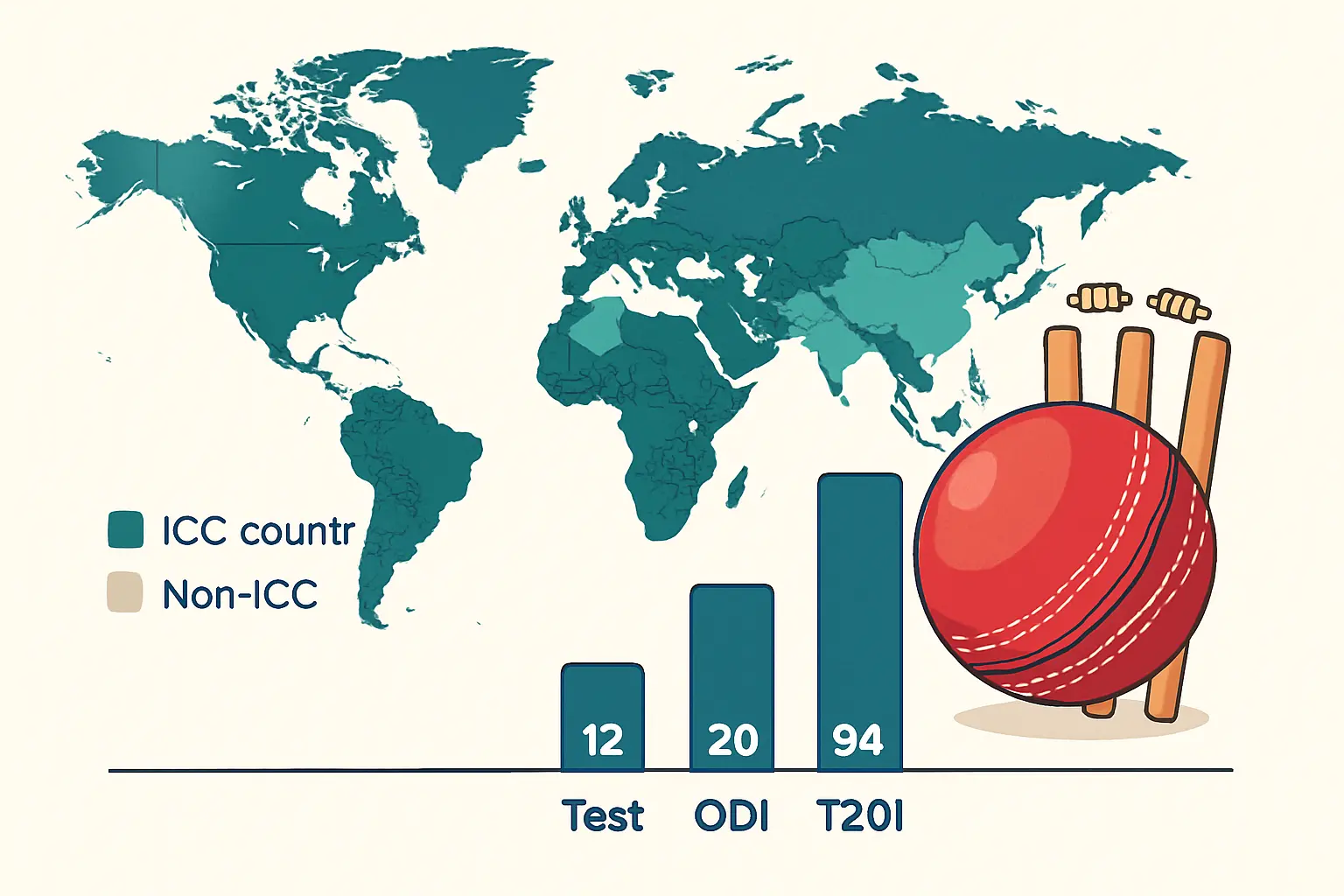
Updated this month: 108 countries play international cricket under the ICC. That includes 12 Full Members and 96 Associate Members. All 108 can play official T20 internationals; 20 currently hold ODI status; 12 play Test cricket.
What “playing international cricket” actually means
The cleanest way to count cricket-playing countries is to follow the International Cricket Council, the sport’s global governing body. ICC membership is the threshold for international recognition. Every ICC member has the right to field a national team in official Twenty20 Internationals (T20Is). From there, two additional layers sit on top:
- ODI status: a limited subset of members, Full and some Associates, are granted One-Day International status.
- Test status: the elite tier reserved for Full Members who meet stricter competitive and infrastructural benchmarks.
In practical terms:
- If a country is an ICC member, it plays international cricket.
- If a country is a Full Member, it can play Tests, ODIs, and T20Is.
- If a country is an Associate Member, it can play T20Is and, in some cases, ODIs. Associates do not play Tests.
The headline numbers at a glance
- Total ICC member countries: 108
- Full Members: 12
- Associate Members: 96
- Test-playing nations: 12
- ODI-status teams: 20
- T20I teams: 108
Format-by-format: who plays what today
Test cricket
- Teams with Test status: 12
- The twelve Test-playing countries are the Full Members of the ICC.
List of ICC Full Members
- Australia
- Bangladesh
- England (governed by the England and Wales Cricket Board)
- India
- Ireland
- New Zealand
- Pakistan
- South Africa
- Sri Lanka
- West Indies (a multi-nation team representing Caribbean territories under Cricket West Indies)
- Zimbabwe
- Afghanistan
Short expert note: Test status is conservatively guarded. Granting it requires more than results in lower formats. It reflects long-term competitive depth, a domestic first-class system, broadcast and commercial stability, and a governance standard that can sustain years of multi-format touring. The last two additions showed how a country’s sustained investment in structure and pathways eventually earns the nod. That bar has not moved; it has, if anything, grown taller.
One-Day Internationals (ODIs)
- Teams with ODI status: 20
- ODI status is held by all 12 Full Members plus 8 Associates
Associate teams with current ODI status
- Netherlands
- Namibia
- Nepal
- Oman
- Papua New Guinea
- Scotland
- United Arab Emirates
- United States of America
Short expert note: ODI status is reviewed through multi-year league pathways. Promotion and relegation across global divisions decide who merits the right to play ODIs. In my trips to League 2 venues, the stakes feel very real. One win or loss in Windhoek, Al Amerat, or Lauderhill can swing funding and fixtures for an entire cycle.
Twenty20 Internationals (T20Is)
- Teams with T20I status: 108
- All ICC members have T20I status
Short expert note: This universal T20I recognition revolutionized growth. Emerging members can now schedule official internationals that count for rankings and player records. It is the single most important policy shift for expanding the sport’s footprint since the global qualifying ladder was created.
What counts as a country in cricket
In cricket, teams are recognized through ICC membership bodies, which sometimes reflect regions rather than single sovereign states. West Indies are the classic example: a confederation of Caribbean nations and territories that compete together under a shared board. England’s team is administered by the England and Wales Cricket Board. Scotland and Ireland field separate national teams. This is why the cricket map does not perfectly overlay with political maps, and why asking how many countries play cricket requires the ICC lens.
The current ICC picture by region
Every region now has live international cricket in some form. The growth is uneven, but the playing field has widened in ways that were unthinkable when I first reported from Associate events.
- Asia: A powerhouse in both heritage and headcount. Beyond giants like India and Pakistan, the region is home to fast-climbing Associates such as Nepal, Oman, and the UAE. Crowds in Kathmandu often pack the Tribhuvan stands for the national team, a fervor that rivals many Full Member venues. Gulf Associates have leveraged infrastructure and expat communities to sustain busy international calendars.
- Europe: The biggest cluster of Associates by volume. You can drive from Hamburg to The Hague to Brussels and find national squads training in compact high-performance domes tucked behind football pitches, SUVs stacked with bowling machines. Germany, Italy, and Spain now regularly notch T20I wins, and the Channel Islands—Jersey and Guernsey—punch well above their size. The Netherlands have parlayed decades of craft into sustained ODI competitiveness.
- Africa: A fiercely competitive Associate scene underpinned by Namibia’s relentless rise, Uganda’s hunger, and Kenya’s ambition to regain past heights. Namibia’s players seamlessly shift from franchise T20 gigs to national duty, their bowling unit especially capable of tight seam spells on surfaces that look benign but bite with the sea breeze in Walvis Bay.
- Americas: The United States and Canada anchor the region with a heavy pipeline of South Asian, Caribbean, and local talent, while Bermuda and the Cayman Islands remain dedicated hotbeds. The USA now host top-flight events and have ODI status; the MLC domestic competition has supercharged fast-tracked development, especially in fast bowling depth.
- East Asia-Pacific: A region of passion projects that are finally being rewarded. Papua New Guinea’s Barramundis have a distinctive brand—fearless cutters and vibrant fielding. Vanuatu, Japan, and the Philippines have grown quietly, each with reliable high-performance centers that I have visited in converted school grounds and modular nets that can be dismantled and reassembled for cyclone season.
The growth arc: admissions, suspensions, returns
Membership rosters shift. A few patterns define the modern era:
- Expansion through clear criteria: Several new Associates have joined after meeting governance and participation thresholds, including federations from Southeast and Central Asia and West Africa. The expansion has sharpened the world qualifier ecosystem, where fresh faces often stun older members who assumed regional dominance.
- Universal T20I status as an accelerant: The moment every member’s T20 matches counted officially, boards could pitch sponsors with tangible international exposure and ranking points. It also improved scheduling leverage; emerging teams could now invite higher-ranked sides and market the fixtures as full internationals.
- Governance oversight: Suspensions do happen when boards fall short on compliance, independence, or development requirements. Some cases are short-lived, resolved through interim committees and constitutional fixes. Others, like the termination of a non-compliant board in Eastern Europe, have proven more final.
- Rebounds do occur: High-profile suspensions have been lifted once reforms landed. Those chaotic months scar a domestic game, but the return often brings cleaner structures and renewed purpose.
Practical guide to ICC membership and status
Difference between Full Member and Associate Member
- Full Member:
- Plays Tests, ODIs, and T20Is.
- Holds a seat at the top governance tables and historically receives larger revenue shares.
- Sustains a multi-tier domestic ecosystem with first-class cricket, structured age-group funnels, and stable facilities.
- Obligation to tour and host across formats in broadcast-linked cycles.
- Associate Member:
- Plays T20Is as of right; may hold ODI status via performance pathways.
- Governed by performance, participation, and governance benchmarks tied to development grants.
- Leans on targeted high-performance hubs rather than sprawling domestic pyramids.
- Gains international fixtures through regional qualifiers, League 2, Challenge Leagues, and bilateral agreements.
How a country gets into the ICC
- Build the base: A national governing body with independent governance, audited accounts, and a strategic plan. Age-group pyramids, women’s participation, and coach-education are counted, not just the men’s senior team.
- Demonstrate participation: Registered players, structured leagues, and regular domestic competitions. I have seen filings from new applicants where school cricket and soft-ball pathways carry real weight.
- Fit the regional context: Integration with an ICC development region and evidence of workable cross-border cricket.
- Clear anti-corruption and integrity commitments: Education and code adoption.
- Apply, then deliver: Admission comes with obligations. The quickest way to lose favor is to go silent between review points. The smartest emerging boards publish their calendars publicly and hold frequent, modest bilateral series that they can reliably deliver.
Why the numbers matter
A single line says 108, but the real story lives in everything that leads to and follows from that number. ODI status opens doors to playing stronger teams and guarantees live broadcast windows. Universal T20I status turns dreams into data—rankings, caps, averages—things sponsors and sports ministries can recognize in a budget line. Full Membership is the end of one journey and the start of the next: an obligation to sustain a domestic first-class circuit and a promise to bring the game to every child with an outstretched hand and a taped tennis ball.
Inside the formats: how teams progress and sustain
Test cricket: the long road
The leap to Test cricket is not a flick of a switch. The journey demands:
- A high-volume domestic red-ball competition: Four-day cricket where batters can bat time and seamers learn to bowl 20 overs across sessions. Without it, Test debuts can become trial by fire.
- Touring cadence: Exposure to different conditions. Even Full Members can stagnate if they only host on familiar surfaces. The best-run boards prioritize varied tours despite the logistical and financial tug-of-war.
- Player depth across roles: Not just a world-class legspinner or a new-ball pair. Test squads need reserve keepers who can bat six sessions under the gun, left-arm seam options, and batters who adapt against reverse swing under the lights.
ODIs: the currency of global growth
- Pathway-driven progress: Associates earn or lose ODI status through League 2 and Challenge Leagues. In dozens of press boxes from Windhoek to Al Amerat, the humble net run rate column has felt like a drumbeat under every over. One missed single in April can decide ODI status next winter.
- Identity and scheduling: Once ODI status arrives, calendars fill. Training loads scale up, workloads are tracked with wearables, and the physio room starts to look like a small city hospital. The national shirt starts visiting more living rooms.
T20Is: the on-ramp sport needed
- Lower barriers to entry: Shorter matches, fewer specialist demands to start with, and the option to stage night games in multi-use facilities. I have watched debutant nations christen unused rugby ovals with drop-in wickets and string lights.
- Skill democratization: A single bowling innovation can rewrite the odds in this format. Associate teams have been early adopters of powerplay match-ups and back-of-the-hand variation. T20Is reward planning as much as pedigree.
The ODI Associates up close
- Netherlands: A program built on continuity. Batting depth with county experience, seamers who thrive in seam-friendly mornings at home, and a core leadership group that has been together for years.
- Scotland: A patient, well-structured side that rarely beats itself. In cool, heavy conditions they are outstanding at hustling singles and bowling hard lengths.
- Namibia: Relentless, athletic, unified. The best Associates side at turning a middle-overs stalemate into a squeeze. Their fielding standards are Full Member grade.
- Nepal: The most fervent home support on the Associate circuit. Wristspin riches, fearless top-order stroke play, and a fan culture that fills entire hilltops with flags.
- Oman: Quiet excellence. They prepare good surfaces, manage player workloads professionally, and play mistake-free white-ball cricket.
- Papua New Guinea: The Barramundis bring energy, agility, and boundless joy. Their off-field community work is as inspiring as their cricket.
- UAE: Infrastructure-rich and strategically savvy, with a seam-bowling factory line and young batters steeped in T20 leagues.
- USA: Unlocked by a strong domestic franchise competition. The batting power in particular has spiked, and the seam attack now carries true pace options.
Cricket beyond the Full Members: a regional tour
Europe’s spread
Cricket in Europe now feels like a constellation of bright nodes rather than a faint trail. Germany’s growth came through community clubs that established rigorous coaching ladders. Spain leveraged expat hubs along the Mediterranean and quality club grounds in Alicante and Malaga to host international events. Italy’s talent pool blends heritage players with academy graduates from Lombardy and Lazio. The Channel Islands set standards in high-performance organization well beyond their population, with Jersey’s age-group pathways envied regionally. Nordic associates such as Sweden and Finland have invested in indoor facilities that make cricket a year-round habit, not a summer fling.
Asia’s nonstop engine
The subcontinent lifts everything around it. Broadcast markets fuel the calendar; talent migration seeds emerging teams; and a bustling club scene across Gulf nations keeps the ball rolling even when national squads are between events. Nepal, Oman, and the UAE are now reliable antagonists for higher-ranked teams on their day. Bahrain and Kuwait push hard; Qatar quietly accumulate sharp T20I wins. The Asian Cricket Council’s tournament structure feeds regular cricket into fresh outposts, where school tournaments now flip between indoor soft-ball and proper leather.
Africa’s punch
Namibia leads in outcomes, but Uganda, Rwanda, and Nigeria shape the narrative of relentless improvement. Kampala’s grounds hum with junior cricket on Saturday mornings. Kigali has emerged as a progressive venue with reliable wickets and broadcast-friendly infrastructure. Kenya is rebuilding with intent, aiming for the consistency that once made them an ODI dark horse. South Africa’s domestic network still underpins the region’s coaching education, even as their national team weathers its own transition cycles.
The Americas awakening
The USA’s presence has changed the energy across the hemisphere. Lauderhill and Grand Prairie host internationals and franchise games; teenagers see a pathway that did not exist a few summers ago. Canada’s storied rivalry remains, and Bermuda’s cricket identity still leans into artistry and flair. Smaller members like the Cayman Islands run tidy operations and develop specialists—accurate medium pacers and electric fielders—tailored to local wickets.
East Asia-Pacific, from passion to performance
Papua New Guinea made belief mainstream. Vanuatu runs one of the most gender-progressive cricket programs I have seen anywhere, with women’s cricket commanding prime slots on community fields. Japan’s youth systems are disciplined and community-led, with indoor nets in suburban school gyms allowing a level of repetition usually associated with baseball. The Philippines cricket community is anchored by volunteers who have turned logistical puzzles into yearly calendars. On good days, the whole region feels like a laboratory, where every session births a new drill or a tweak to training loads.
Countries often asked about
- United States of America
- Status: ICC Associate Member
- Formats: T20I and ODI
- Snapshot: The national team draws on a diverse pool across coasts. Major League Cricket has boosted seam pace and fielding intensity. The pathway from club to national cap is clearer than it has ever been.
- China
- Status: ICC Associate Member
- Formats: T20I
- Snapshot: Development has focused on school and university structures, especially in women’s programs. The domestic footprint is not yet dense, but administrative stability and youth engagement provide a base.
- Russia
- Status: Not currently an ICC member
- Snapshot: Membership issues centered on governance and compliance. Domestic enthusiasts exist, but official international pathways are closed without ICC membership.
- Germany
- Status: ICC Associate Member
- Formats: T20I
- Snapshot: Rapid expansion through well-run migrant and local club structures. The national team now mixes homegrown talent with seasoned leaders who set tactical discipline.
- Japan
- Status: ICC Associate Member
- Formats: T20I
- Snapshot: Youth systems are orderly, and coaching quality has risen. Emphasis on skills repeatability echoes the country’s other bat-and-ball sport.
A note on suspended members
- Suspensions arise from governance failures or political interference. Some are temporary, lifted after reforms; others lead to termination.
- Suspended members cannot play ICC-sanctioned internationals. Athletes often lose formative years in limbo. When reinstatement comes, rebuilding takes patience.
Cricket at the Olympics and multi-sport games
With T20 recognized across more multi-sport platforms, ICC members see Olympic and continental games as accelerators. Eligibility is fixed by ICC membership and national Olympic committees, so the 108-member map largely tracks where T20 can appear in qualifiers. For Associates, the Olympics are more than medals—they are ministry budgets, visa letters for tours, and leverage for better grounds. The ripple effects, measured in junior registrations and women’s participation, tend to exceed what a typical qualifier can do.
Why some countries excel faster
- Coaching stability: A national head coach who stays across cycles can make ordinary squads achieve extraordinary cohesion. Scotland’s method, Namibia’s identity, and Nepal’s spinners’ guild showcase what stability breeds.
- Facilities that match goals: Oman’s Al Amerat complex is the case study. Purpose-built grounds, consistent wickets, and broadcast readiness created a virtuous circle of hosted events and competitive home results.
- Player retention: Associates fight the pull of full-time day jobs. Central contracts and modest match fees, even if limited, can buy more training hours and a chance to refine second spells and death overs.
- Bilateral bravery: Teams willing to tour and host outside their comfort zones improve faster. The best-run boards do not chase only favorable conditions. They chase opportunities that stretch their team.
Misconceptions that still block growth
- That cricket is only for a handful of Commonwealth nations: Attendance in Berlin, Rome, Kathmandu, and Dallas disabuses that notion fast. The sport now lives on every continent through official internationals.
- That T20 is a trivial format: It is the gateway. Nations build identity, test skills under pressure, and learn how to win. Everything else—ODIs, even Tests—rides the energy and investment unlocked through T20 achievement.
- That Associates lack elite players: Watch a left-arm Namibian seamer hooping it at dusk in Johannesburg, or a Nepali legspinner teeing up a batter with three different wrong’uns in the space of two overs. Talent is everywhere; the difference is volume and opportunity.
A concise dataset you can lean on
- ICC members: 108
- ICC Full Members: 12
- ICC Associate Members: 96
- Test-playing nations: 12
- ODI-status teams: 20
- T20I-status teams: 108
Note on volatility: Test count is stable; ODI count can change with pathway results; T20I count tracks total ICC membership.
How the ICC number can change
- New admissions: When a national board demonstrates governance and participation thresholds, it can be voted in as an Associate.
- Terminations and suspensions: Governance lapses can remove members from the list or pause them.
- Mergers or structural shifts: Rare, but in theory possible, especially for teams administered as collective entities or where domestic sport governance law is rewritten.
A guided tour of Full Members, stylistically
- Australia: Fast-wicket schooling, aggressive fields, and the confidence to bat first on green mornings. Their domestic system is a conveyor belt that rarely breaks.
- Bangladesh: A spin-rich culture with fearless batters at home who are learning to export that confidence abroad.
- England: A deep pool with county cricket at its spine. White-ball innovation often runs a few months ahead of everyone else.
- India: A factory of batting and fast-bowling depth with domestic pressure so intense that a debutant arrives battle-tested.
- Ireland: Gritty, organized, and unafraid to chase tall targets. Domestic professionalism has risen sharply.
- New Zealand: Tactical clarity, smart selection, and an almost scientific approach to match-ups.
- Pakistan: Mercurial at times, brilliant often. Seamers appear as if conjured; wristspin artistry persists.
- South Africa: Athletic excellence and a commitment to pace bowling that reads like a manifesto.
- Sri Lanka: Batters bred on patience and touch, spinners born with guile. Rebuilds do not erase cricketing instincts refined over generations.
- West Indies: Power-hitting royalty with a deep seam of T20 mastery. When the red-ball alignment clicks, the romance of Test cricket flows through them like a memory regained.
- Zimbabwe: A proud cricket nation in phases of renewal. The home crowd’s memory is long; the hunger to host is undimmed.
- Afghanistan: A miracle of modern sport. Wristspin genius, raw pace, and a domestic passion that has survived adversity to build a formidable program.
Key Associate stories that shape the landscape
- Namibia’s blueprint
- Central contracts that match development budgets to on-field roles.
- A calendar that avoids long idle gaps; practice games against stronger neighbors.
- A fielding standard that compresses opponents’ scoring options.
- Nepal’s surge
- A golden generation of spinners and a top order built on audacity.
- Fans who turn every home fixture into a festival, compelling broadcasters to invest.
- A board learning the hard truth that careful match scheduling beats overreach.
- USA’s pivot
- Respectable domestic structures paired with a headline franchise tournament.
- Investment in pace bowling and wicketkeeping, areas often in short supply at emerging levels.
- An administrative focus on clean governance to avoid footsteps that tripped earlier iterations.
- The Netherlands’ durability
- A club scene that sustains a national core through county and franchise opportunities.
- Fearless World Cup cricket that creates heroes every cycle.
- Junior pathways that place technique first and lean on sports science.
The ODI vs T20I balance for Associates
- ODIs: Developmental gold for bowlers who need 10-over spells and batters who must reset mid-innings. Associates who sustain ODI status often improve fastest in T20Is as a byproduct.
- T20Is: The earnings format and the visibility engine. Win a T20I against a top side and your cricket budget for next spring starts to look different.
Essential glossary for this page
- ICC: International Cricket Council, the sport’s global governing body. Sets membership, rules, and global pathways.
- Full Member: An ICC member with rights to play Tests, ODIs, T20Is and broader governance privileges.
- Associate Member: An ICC member without Test rights; can play T20Is and, if granted, ODIs.
- Test cricket: The longest format, played over multiple days between Full Members.
- ODI: One-Day International cricket, 50 overs per side, played by Full Members and ODI-status Associates.
- T20I: Twenty20 International cricket, 20 overs per side, played by all ICC members.
Data sources and update approach
- ICC Members page: The official roster of Full and Associate Members, plus any notices of suspension or termination.
- ICC playing conditions and media releases: The definitive word on status changes.
- ESPNcricinfo team hubs and results archives: Useful to track which Associates are playing ODIs in the current cycle.
- National board communications and regional development councils: Often first to announce fixture lists and structural reforms.
This page is reviewed frequently and refreshed whenever the ICC adjusts membership or status. The headline counts above reflect the latest official roster at time of writing.
Why the featured number sits at the top
Readers deserve the answer fast. Editors hate soft intros when the query is simple. The number is the start, not the sum, of what matters here. From that single line, you can now jump into the format tables, check which nations sit where, and understand how a country moves up or down. Cricket’s global map is bigger than most imagine; it is also more dynamic. A small board’s honest balance sheet and a school tournament in a new city can change the next update on this page.
Final takeaways
- Total ICC members today: 108, each with T20I status.
- Test nations: 12 Full Members.
- ODI teams: 20, reflecting performance-driven status for 8 Associates in addition to the 12 Full Members.
- The map is fluid: admissions, suspensions, and status shifts happen. The direction of travel favors growth and accountability.
- Behind the counts live programs, volunteers, and players who chase a harder dream than most professionals—making a nation believe it plays cricket as truly as anyone.
Last reviewed this month.

Zahir, the prolific author behind the cricket match predictions blog on our article site, is a seasoned cricket enthusiast and a seasoned sports analyst with an unwavering passion for the game. With a deep understanding of cricketing statistics, player dynamics, and match strategies, Zahir has honed his expertise over years of following the sport closely.
His insightful articles are not only a testament to his knowledge but also a valuable resource for cricket fans and bettors seeking informed predictions and analysis. Zahir’s commitment to delivering accurate forecasts and engaging content makes him an indispensable contributor to our platform, keeping readers well informed and entertained throughout the cricketing season.