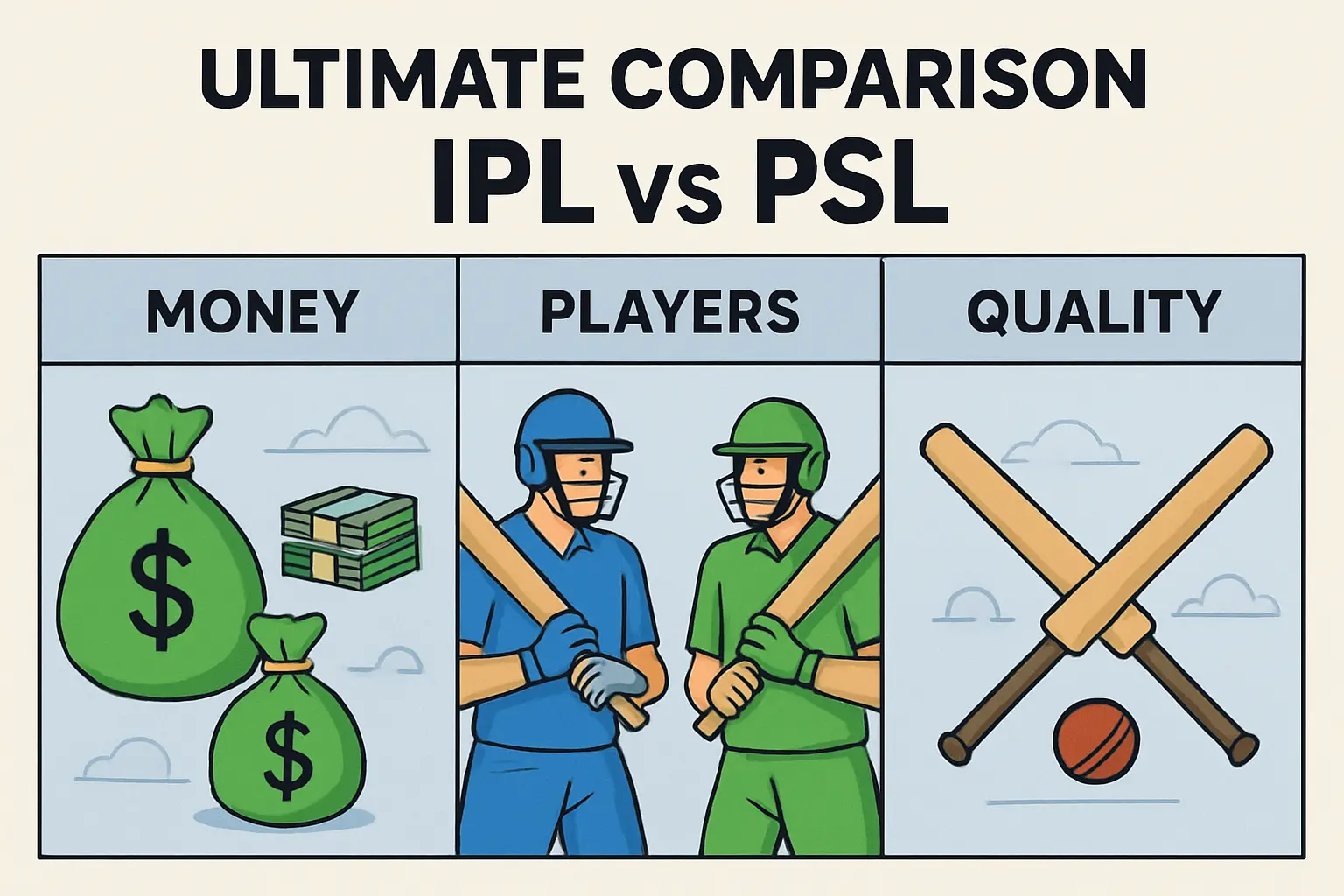
Two leagues, two cricketing cultures, one irresistible debate. The Indian Premier League and the Pakistan Super League have grown into distinct expressions of T20 cricket: one colossal and commercially unmatched, the other raw, intense, and fiercely competitive. I’ve covered both from the press box and from the dugout tunnel, felt the thrum of giant Indian arenas and the gritty electricity of Lahore and Rawalpindi nights. Strip away the noise and you find two ecosystems built on different pillars, serving different audiences, yet chasing the same excellence. This is a granular, neutral, data-led look at IPL vs PSL—money and valuations, viewership and fan culture, player dynamics, on-field quality, formats and rules, and how each league reflects the cricket DNA of its home.
Summary: Which league is “bigger” and why
- Scale: IPL is the global commercial leader by a distance—revenue, franchise value, broadcast rights, and salary structure. The business model and market size give it the broadest economic footprint of any T20 league.
- On-field identity: PSL has a deserved reputation for elite bowling—especially high pace, hard lengths, and hostility. IPL showcases a wider range of styles, with unmatched finishing power, deeper batting line-ups, and a higher overall concentration of all-format superstars.
- Viewership: IPL dominates in audience volume globally—bigger TV reach, massive digital peaks, and unmatched domestic penetration. PSL delivers extraordinary engagement relative to its market size and owns prime attention in Pakistan and the diaspora.
- Player dynamics: IPL offers the highest salaries and the densest cluster of global icons. PSL’s talent pipeline (notably fast bowling) is excellent and has cultivated a quality-over-quantity ethos—overseas signings who come are generally impact players.
- Structure and rules: IPL’s auction and Impact Player rule create a specific brand of tactical volatility. PSL’s draft ensures more uniform team values, nurturing close contests and a higher share of low-scoring thrillers.
- Competitive parity: PSL often feels more bowler-led and evenly matched; IPL often feels more situationally tactical, with batting depth and late-over power frequently deciding games.
Verdict: IPL is the bigger league by money and global pull; PSL often delivers purer bowling contests and razor-edge finishes. “Better” depends on what you value: economic scale and superstar density vs. bowling quality and game tension.
Money: Revenue, franchise values, prize money, salaries
The business gap between IPL and PSL is significant. It doesn’t take away from PSL’s quality; it simply reflects the size of the Indian market and BCCI’s commercial framework. Here’s how the money breaks down, category by category.
Revenue and brand value
- IPL revenue: Enormous. Domestic and global broadcast rights alone dwarf entire T20 economies. Commercial floors are propped up by long-term central deals, powerful digital rights packages, and an industrial-strength sponsorship ecosystem.
- PSL revenue: Respectable and growing. Central rights, sponsorships, and gate receipts are healthy within Pakistan’s economy but comparatively smaller. PSL’s brand value is climbing, supported by a clear identity and loyal domestic base.
Franchise valuations
- IPL franchises: Valued in the billions for marquee teams. Brand strength, multi-city fanbases, and deep corporate partnerships lift enterprise value well beyond matchday and on-season metrics.
- PSL franchises: Typically valued in the tens of millions. Valuations are rising as profitability stabilizes and the league’s continuity matures, but the delta with IPL is structural given market size and monetization options.
Salaries and salary cap
- IPL salaries: Highest in T20 cricket. Top stars command multi-million-dollar paychecks across retentions and auction buys. Team salary purses are large enough to create genuine bidding wars for scarce skill-sets (death overs hitters, left-arm quicks, wrist-spinners who bat).
- PSL salaries: Structured by draft categories. Top bracket (Platinum) is valuable by global standards but an order of magnitude below IPL’s elite salaries. Teams manage a tight overall spend with an emphasis on role fit and balance.
Prize money and incentives
- IPL: Substantial winner and runner-up pools, additional bonuses tied to performance and league awards, significant team-led incentives.
- PSL: Attractive winner’s check for the market, performance bonuses, and add-ons, though on a smaller quantum than IPL.
Sponsorship deals and inventory
- IPL: Trophy sponsors, multiple on-ground partners, sleeve/helmet/plasticity of branding, broadcast presenting and co-presenting partnerships, and a full stack of digital ad formats. Inventory sells at premium rates due to reach and frequency.
- PSL: Central sponsorships and team deals are solid. Rates are proportionate to market realities, with strong resonance in Pakistan and diaspora markets tuned into national talent narratives.
Ticket prices and matchday
- IPL: Wide band, from affordable to premium hospitality. New-age arenas and large capacities allow tiered pricing strategies.
- PSL: Accessible for domestic fans, with smaller capacities and a higher ratio of die-hard supporters. Atmosphere can be raucous and intimate.
A quick comparison snapshot (indicative ranges):
Money Metrics: IPL vs PSL (indicative)
- League revenue: IPL = Very high; PSL = Moderate
- Franchise value: IPL = Billion-scale for top clubs; PSL = Tens of millions typical
- Top player salary: IPL = Multi-million; PSL = High six-figure (USD) range
- Team salary cap/purse: IPL = High; PSL = Low–medium
- Prize money: IPL = High; PSL = Medium (market-relative)
- Sponsorship rates: IPL = Premium; PSL = Value-focused
- Ticket prices: IPL = Wide range; PSL = Generally lower
- Brand value trajectory: IPL = Established leader, still growing; PSL = Growing steadily
IPL wins on absolute audience numbers. PSL wins on intensity relative to market size. Both benefit from a cricket-mad base, tradition, and star pull.
TV ratings and TRP
- IPL: TV draw is unmatched. Regional feeds, deep cable/satellite penetration, and appointment viewing make it a reliable primetime juggernaut. High cumulative reach across the season.
- PSL: Excellent ratings within Pakistan. Prime match slots, free-to-air presence in phases, and national identity fuel strong TRPs.
Digital streaming and concurrency
- IPL: Digital viewership has exploded due to aggressive platform strategy, sometimes with free streaming in the domestic market, pushing peak concurrency to world-leading levels for live sports.
- PSL: Strong digital following in Pakistan and the diaspora. Concurrency is healthy and growing as data costs fall and mobile-first consumption expands.
Attendance and match atmosphere
- IPL: Bigger stadiums, more fixtures, more mega-cities. Attendance numbers are massive across the board, with marquee matches filling to the rafters.
- PSL: Electric atmosphere in core venues. Capacities are smaller, but decibel levels often higher per capita, especially when fast bowlers get on a roll.
Social media followers and Google Trends
- IPL: Dominant league-level and team-level followings across platforms, with content factories humming year-round. Google Trends reflect top-of-mind dominance during the window.
- PSL: Strong league and team growth on social. Fanbases are passionate, players are deeply connected culturally, and team accounts punch above their weight on engagement.
Global audience
- IPL: Truly global, driven by Indian diaspora and neutral fans chasing the biggest stars and rivalries.
- PSL: Robust diaspora audience in the Gulf, UK, and North America, and neutrals who value bowling-centric T20.
Indicative reach and engagement snapshot:
Viewership & Popularity: IPL vs PSL (indicative)
- TV reach: IPL = Very high; PSL = High in core market
- TRP consistency: IPL = High across season; PSL = High in Pakistan
- Digital peak concurrency: IPL = World-leading; PSL = Growing strongly
- Average attendance: IPL = Very high; PSL = Moderate–high (smaller capacities)
- Social followers: IPL = Largest among T20 leagues; PSL = Fast-growing
- Google Trends share during season: IPL = Dominant; PSL = Strong regionally
Players and participation: Availability, star power, development
Foreign players and availability
- IPL: Nearly every elite overseas T20 star puts the window on their calendar. Availability is generally strong, though international commitments and national boards’ policies can affect portions of the season. The league pulls from deep talent reservoirs across Australia, England, South Africa, New Zealand, the Caribbean, and associate nations.
- PSL: High-caliber overseas signings—often middle-order hitters, quality seamers, and leg-spinners who relish Pakistan conditions. Availability can be affected by overlapping international windows or late-season clashes, but those who come are often indispensable.
Pakistani players and the IPL
Pakistani players don’t feature in the IPL. The reasons are political and administrative, not cricketing. NOC and cross-border relations determine eligibility; the status quo keeps that door closed. This is one of the biggest “what ifs” in T20 cricket.
Which league pays more?
IPL, by a distance. The top end of the IPL pay scale eclipses the entire PSL roster spend for some teams. Even mid-tier IPL salaries often exceed top-bracket PSL contracts.
Depth and star concentration
- IPL: An almost absurd density of global A-listers and national heroes. It’s not just the household names; the second and third tiers include the best role players from multiple countries—specialist finishers, mystery spinners, 140-plus hit-the-deck seamers, left-arm orthodox all-rounders who can bat in the top six.
- PSL: Concentrated quality in fewer teams. The pipeline is especially strong in fast bowling and wrist-spin. Overseas pros are curated to fit roles that matter in Pakistan’s T20 conditions.
Domestic development and scouting ecosystems
- IPL: Franchises invest heavily in scouting networks, academy programs, and analytics departments. Talent is tracked across domestic tournaments, age-group cricket, and franchise leagues worldwide. Young players learn pressure management in packed stadiums and train with world-class coaches and support staff—batting consultants, biomechanics experts, S&C specialists.
- PSL: Some teams have built best-in-class scouting, with Lahore Qalandars’ player development pipeline a widely cited success story—turning raw pace into polished match-winners. PSL’s smaller ecosystem means faster elevation from discovery to first XI.
Role-by-role strength: batters, bowlers, all-rounders, wicketkeepers
- Best batters: IPL’s top order is imposing and deep across teams. PSL’s batting quality is improving, with several local anchors adopting higher intent and overseas hitters bringing death-over muscle.
- Best bowlers: PSL has a reputation for fast-bowling excellence—hard lengths, bounce, whippy pace, and well-honed yorkers. IPL’s bowling depth is broader across pace and spin, with different conditions enabling finger-spin, wrist-spin, cutters, slow-bouncers, and knuckleballs to thrive.
- All-rounders: IPL has more elite all-rounders at once, which affects team balance, finishing ability, and bowling options. PSL often fields bowling all-rounders who can hit long but may not bat in the top six as consistently.
- Wicketkeepers: IPL’s pool is super competitive—many keepers are also top-six batters. PSL’s keeping standards are solid and improving, with several athletic glove-men who can float between six and eight.
On-field quality: Bowling, batting, strike rates, powerplays, death overs
Watch a PSL powerplay, and you’ll feel the ball thudding into the keeper’s gloves more often. Watch an IPL chase, and you’ll see late-over calculus executed with almost robotic precision: matchups, boundary percentage predictions, and fielding resource placement honed by data.
Bowling quality and pace vs spin
- PSL bowling quality: A defining characteristic. Pace on, attacking lengths, and well-schooled death bowling produce match-ups that stress-test technique and temperament. Wrist-spin punches above its weight, with leg-breaks and wrong’uns weaponized by good fielding plans.
- IPL bowling quality: Deeper and more varied. You get express pace, you get wrist-spin, but you also get cutters that grip on used pitches, change-ups that are disguised with higher-arm release points, and spinners who bowl webbed fields to choke eight-an-over chases.
Batting approaches and finishing
- IPL batting: Deeper benches, multiple finishers per side, and match-winning cameos from positions seven or eight. Strike-rate expectations are brutal; if you can’t sustain intent, you don’t last in a role. Chase plans routinely account for the Impact Player cushion.
- PSL batting: More binary—teams either dominate early or are forced to rebuild against quality new-ball spells. Finishing power is there, but not across as many teams. The best PSL sides, though, press ruthlessly in overs 16–20 and thrive under scoreboard pressure.
Fielding standards and match intensity
- IPL: Fielding is uniformly high, with specialist boundary riders, elite inner-ring athletes, and throw accuracy that squeezes singles. You will still see the odd drop—pressure does that—but the mean standard is exceptional.
- PSL: The top teams field brilliantly; the average has risen season over season. Direct hits at crucial moments are a PSL hallmark. Energy is off the charts in packed Pakistan venues.
Scoring trends, strike rates, and situational stats (indicative ranges)
- Average first-innings scores: IPL often trends higher (roughly mid-160s to mid-170s) due to batting depth and flatter decks in several venues. PSL tends to sit slightly lower (roughly mid-150s to mid-160s), reflecting tougher new-ball spells and more bowling-friendly surfaces.
- Powerplay scoring: IPL powerplays can be explosive, especially in batter-friendly venues. PSL powerplays feature more wickets and lower run rates on average, a function of high-quality new-ball pace.
- Death overs: IPL’s last-five surge is lethal; PSL’s last-five is often a duel between elite yorkers and hitters who trust their range. Economy rates at the death may be marginally better in PSL, but IPL’s finishing talent often negates that.
- Dot-ball percentage: Typically higher in PSL, especially early. IPL’s dot-ball percentage compresses later as batting depth bites.
Indicative on-field metrics snapshot (ranges vary by venue and season):
On-Field Metrics: IPL vs PSL (indicative)
- Avg first-innings score: IPL = ~165–175; PSL = ~155–165
- Powerplay run rate: IPL = ~8.0–9.0; PSL = ~7.5–8.5
- Death economy: IPL = ~9.5–11.5; PSL = ~8.8–10.8
- Dot-ball percentage: IPL = ~42–46%; PSL = ~45–49%
- Four-over wicket impact leaders: IPL = mix of pace and wrist-spin; PSL = pace-dominant with effective leg-spin
Structure and rules: Auction vs draft, format, venues
IPL and PSL are built differently by design. The consequence is two distinct flavors of T20.
Auction vs draft
- IPL auction: Chaotic, costly, and thrilling. Franchises construct squads with aggressive bidding, forcing trade-offs and driving up prices for scarce skills. Retentions and right-to-match rules vary by cycle. The auction creates big winners, bargain maestros, and inevitable gaps teams must coach around.
- PSL draft: More controlled. Predefined categories, pick orders, retentions, and trade windows shape balanced rosters. The draft encourages role-based thinking and keeps overall salary structures tight. It reduces extreme inequality.
Number of matches and playoff format
- IPL: Larger league, more matches, extended window. Playoff system rewards top-two with a second chance (Qualifier 1, Eliminator, Qualifier 2, Final). The format helps the best teams survive one off day.
- PSL: Compact league with an Eliminator-heavy playoff path (Qualifier, Eliminator 1, Eliminator 2, Final). The final stretch can feel like a street fight—teams earn their runs in a pressure cooker.
Venues and schedule window
- IPL venues: Spread across multiple Indian cities, each with identity pitches—wickets that suit finger-spin in some, flat-track batting in others, humid night games elsewhere. The travel and logistics are massive.
- PSL venues: Karachi, Lahore, Rawalpindi, Multan have offered varied surfaces—swing and seam early, true bounce when the weather aligns, and occasionally dry turners. PSL has also staged games in the UAE at times, giving it a second home for contingencies.
Retention rules and squad dynamics
- IPL retentions can be strategic weapons—locking in cores, building around domestic pillars, and planning multi-season arcs. Impact Player has amplified the value of domestic utility cricketers who can perform one specialized role.
- PSL retentions are limited and structured. Trades prior to the draft can reshape team identity, but squads rarely drift into imbalance because categories guide construction.
Substitution and tactical rules
- IPL introduced an Impact Player substitution. It changed tactical rhythms: batting-heavy elevens can bring in an extra bowler later, or vice versa, neutralizing the toss to a degree and inflating finishing potential.
- PSL has stuck closer to classic T20 rules. Strategy is purer in the sense that teams live with their XI’s strengths and weaknesses. It’s why new-ball wickets in PSL can rewire entire games.
A structural comparison snapshot:
Structure & Rules: IPL vs PSL
- Squad assembly: IPL = auction; PSL = draft
- Retention system: IPL = flexible within cycle; PSL = category-limited
- Substitution rule: IPL = Impact Player; PSL = traditional XI
- Playoffs: IPL = double chance for top two; PSL = Eliminators-heavy
- Venues: IPL = pan-India; PSL = Pakistan core + UAE contingencies
- Matches per season: IPL = higher volume; PSL = compact
- Strategy flavor: IPL = adaptation via substitutions; PSL = role fidelity rewarded
Broadcast, streaming, and availability
Broadcast rights value and platforms
- IPL: Domestic rights are among the most valuable in world sport. Digital rights alone set benchmarks for live streaming. Distribution spans linear TV, OTT platforms, and international networks with language localization.
- PSL: Domestic rights have grown steadily, with solid international carriage in countries with large Pakistani communities. OTT distribution is improving, with packages for mobile-first audiences.
Streaming experience and tech stack
- IPL live streaming: Multi-language commentary choices, 4K options in select markets, rich data overlays, and multiple camera angles for key games. Digital user experience has become a brand differentiator.
- PSL live streaming: Cleaner interfaces, improved reliability, and competitive bitrate in most territories. Increasing emphasis on highlights packaging and short-form social content.
Commentary languages and presentation
- IPL: Broadest language slate in cricket—regional commentary has deepened the league’s cultural embed. Presentation is glossy, high-budget, and built for a family primetime.
- PSL: English and Urdu/Hindi-focused, direct and punchy. Studio panels often include former Pakistan stars who speak candidly about technique and selection narratives.
Advertising models
- IPL: High CPMs on digital and premium TV spot rates. Innovations include shoppable ad layers, split-screen commercial formats, and DRM-enabled content splicing for dynamic ad insertion.
- PSL: Strong brand fit with national companies and telcos, category exclusives for major sponsors, and rising interest from global brands seeking South Asian reach.
Players, quality, money—rolled together
If you only read one paragraph in this entire comparison: IPL is the richest and most-watched T20 league, with the densest cluster of international superstars and the most sophisticated commercial engine. PSL is the most bowling-intense elite league, with per-match tension that often feels closer to international T20—fewer resource safety nets, sharper new-ball periods, and great theater under lights. That’s the heart of IPL vs PSL quality.
Bilingual micro-answers for localized queries
IPL vs PSL kaun better hai:
Money, reach, aur superstar depth ke hisaab se IPL aage hai. Bowling quality aur close matches ke liye PSL bahut strong hai. Aapko kya pasand hai—glitz ya grit—us par depend karta hai.
PSL vs IPL kon behtar:
Paisa aur global viewership ke hisaab se IPL. Pace aur death bowling ke angle se PSL. Dono leagues top-tier hain, bas flavor alag hai.
IPL PSL me farq:
IPL auction-based, Impact Player rule ke saath; PSL draft-based, traditional XI. IPL batting depth zyada; PSL pace aur new-ball spells tough.
PSL vs IPL konsi league badi hai:
Scale aur revenue ke hisaab se IPL badi. PSL apne market mein elite product deta hai.
Quality deep dive: examples and tendencies only insiders notice
- PSL new ball: You see length balls taking off from back of a length in Karachi and Lahore. Batters often start with outside-off discipline because the deviation at shoulder height is real. That brings square-of-the-wicket runs and quick edges to slip or keeper. It’s why PSL powerplays have a different sound—the ball sings more.
- IPL middle overs: Wrist-spin with packed off-side fields in some venues; in others, cutters into the pitch aiming for shoulder-high contact. Batters hunt certain lengths and knit 6-8 singles an over knowing the death overs will open floodgates with the Impact Player leverage.
- PSL death overs: Yorkers and hard lengths more than slower-ball spam. When hitters win, it’s because they read the seam early and trust bat-swing lines, not because the ball sits up to be hit.
- IPL finishing: Designated finishers build innings around matchups and boundary rates, not just instincts. Left-right pairs, short-side targeting, and phasing strike-rotation—they’re baked into planning. That’s why totals that feel par elsewhere are 10-15 light at certain IPL venues.
- Fielding nuance: In PSL, you’ll often see the ring pushed tighter in overs 7–10 to block easy singles and force hitters into the wind. In IPL, boundary riders are masters at the relay and the bat-pad edge is patrolled by middle infielders with baseball-grade footwork.
Comparisons with other leagues
- IPL vs PSL vs BBL/CPL/SA20/ILT20: IPL remains the economic and star-power apex. SA20 and ILT20 have spiked overseas player demand, offering alternative windows with excellent pay. PSL often ranks second or third by purists focused on bowling, intensity, and match tension. BBL built a family-first brand, CPL offers festival cricket, and SA20 is rising fast thanks to strong South African talent plus overseas infusion.
- Bowling quality composite: A plausible ranking by pace quality alone often puts PSL neck-and-neck with international T20. That’s a statement on skill density, not just speed guns.
Auction vs draft: how team-building philosophy changes the product
- Auction (IPL) incentivizes bold bets: Spend big to solve a unique problem, then back your academy and analytics to plug the rest. It creates volatility—teams can lurch from average to champion with one mega buy.
- Draft (PSL) rewards balance and scouting: Identify undervalued skill-sets, pull levers in trades, and back your development program. The ceiling is reachable if your local core clicks.
Team-level thought experiments
- Mumbai vs Lahore Qalandars: A clash of batting depth and death-over planning against raw pace and attacking lines. Mumbai tries to drag it deep and trust finishers; Lahore aims to break the chase early with new-ball strikes and hold back a quick for overs 17–20.
- Chennai vs Islamabad United: Chennai’s structure obsession and matchup mastery vs Islamabad’s ability to ride hot streaks from their top order. Spin in the middle overs vs intent in the arc between long-on and deep midwicket. Fascinating chess.
- Kolkata vs Peshawar Zalmi: Power-hitting and wrist-spin traps from Kolkata against Zalmi’s pace and middle-order counterpunchers. The game pivots on whether Zalmi’s pacers can keep Kolkata’s left-handers quiet in the first 10.
People Also Ask: clear, direct answers
Which league pays more: IPL or PSL?
IPL. Top IPL contracts are in the multi-million range, with strong mid-tier salaries. PSL pays well within its structure but at a fraction of IPL’s top end.
Why don’t Pakistani players play in the IPL?
Political and administrative realities, not cricketing ones. Permission and bilateral relations influence eligibility; those conditions have not aligned to allow participation.
Is PSL better than IPL for bowlers?
Many bowlers love PSL conditions: lively new ball, good carry, and a tactical premium on execution. IPL has elite bowlers too, but batting depth and substitution options often tip the format toward hitters. If you’re a quick who relishes early swing and bounce, PSL can feel tailor-made.
Who has higher TV ratings and viewership: IPL or PSL?
IPL leads globally in both TV and digital reach. PSL dominates in Pakistan and commands serious diaspora attention. Relative to market size, PSL’s engagement is outstanding.
Which is more competitive: IPL or PSL?
PSL often feels tighter because drafts compress team strength and conditions empower bowlers. IPL’s competition is ruthless too, but deeper batting and Impact Player flexibility can separate elite squads. Both produce cliffhangers; PSL’s share of nail-biters often feels higher.
Is PSL the second-best T20 league?
Depends on the metric. By money and reach, leagues like SA20 and ILT20 have mounted strong cases recently. By bowling quality and tension per match, PSL is often ranked near the top by coaches and players who’ve done the grind.
Broadcast and streaming FAQs
IPL vs PSL live streaming:
In India, IPL’s streaming footprint is vast with multi-language feeds; PSL streams through regional partners and global OTT options. In Pakistan, PSL streams are widely available across major platforms with Urdu/English commentary.
IPL vs PSL streaming platforms:
Vary by territory. IPL features on the biggest Indian digital platforms; PSL features on leading Pakistani networks and licensed global platforms.
IPL vs PSL broadcast partners:
Rotating per cycle; IPL commands premium broadcasters and wide carriage. PSL partners with major channels in Pakistan and international networks targeting diaspora.
IPL vs PSL commentary languages:
IPL offers the broadest language palette in world cricket; PSL focuses on English and Urdu/Hindi with growing regional reach.
IPL vs PSL HD 4K broadcast:
IPL frequently offers 4K options in select markets; PSL offers HD across most feeds and is steadily upgrading production standards.
Pros and cons: concise, honest trade-offs
IPL pros
- Highest revenue, salaries, and franchise value
- Deepest star power and global pull
- Advanced broadcast and streaming experiences
- Tactical complexity elevated by Impact Player
- Massive attendance and electric big-city atmospheres
IPL cons
- Batting depth can blunt the bowling narrative
- Auction volatility can skew roster balance
- Schedule length and travel load can affect freshness
PSL pros
- Bowling quality—pace and execution—second to none
- Close, tense matches; pressure cricket with fewer safety nets
- Draft keeps teams balanced and contests honest
- Local fast-bowling pipeline is elite, feeding national team success
- Passionate atmospheres in cricket-loving cities
PSL cons
- Lower total revenue, salaries, and global star density
- Smaller venue capacities limit attendance
- Overseas player availability can be patchy during certain windows
Money, viewership, and quality—how it all maps to “which is better”
If your yardstick is money, audience scale, and star consolidation, IPL is the clear winner. If your yardstick is bowling intensity, low-scoring tension, and matchups that feel like international T20 nights, PSL is the connoisseur’s cup of chai. The sensible cricket answer is to love both for different reasons.
Cricket’s modern beauty is that both can coexist, each elevating a different part of the T20 canvas. If you crave the hurricane of star power and tactical abundance, IPL will own your evenings. If you crave the thrill of uncertainty and feel of the ball zipping past a defensive prod at 145-plus, PSL will get under your skin.
Tables: side-by-side clarity
1) Money and commercial structure (indicative)
| Category | IPL | PSL |
|---|---|---|
| League revenue | Very high | Moderate |
| Franchise value | Billion-level for top | Tens of millions typical |
| Top player salary | Multi-million USD | High six-figure USD |
| Team salary purse | High | Low–medium |
| Prize money | High | Medium |
| Sponsorship yield | Premium | Value-focused |
| Ticket pricing | Wide range | Generally lower |
| Rights value | Global benchmark | Strong domestically |
2) Viewership and fandom (indicative)
| Metric | IPL | PSL |
|---|---|---|
| TV reach | Very high | High in Pakistan |
| TRP consistency | High | High domestically |
| Digital peaks | World-leading | Strong, growing |
| Attendance | Very high | Moderate–high (smaller stadiums) |
| Social followers | Largest in T20 | Fast growth |
| Google Trends share | Dominant | Strong regionally |
3) On-field metrics and style (indicative)
| Metric | IPL | PSL |
|---|---|---|
| Avg 1st-innings runs | ~165–175 | ~155–165 |
| Powerplay RR | ~8.0–9.0 | ~7.5–8.5 |
| Death economy | ~9.5–11.5 | ~8.8–10.8 |
| Dot-ball % | ~42–46% | ~45–49% |
| Bowling feel | Varied pace-spin | Pace-dominant, leg-spin impact |
4) Structure and rules
| Aspect | IPL | PSL |
|---|---|---|
| Team building | Auction | Draft |
| Retentions | Flexible by cycle | Category-limited |
| Substitution | Impact Player | Traditional XI |
| Playoff design | Double chance for top two | Eliminators-centric |
| Venues | Pan-India | Pakistan core + UAE contingency |
| Matches | Higher volume | Compact schedule |
Sources and methodology
- Data sources: League press releases and media guides, broadcaster and digital platform releases, audience measurement agencies (for TV ratings/TRP and digital concurrency), brand valuation reports, reputable sports business publications, and franchise disclosures where available.
- Normalization: Monetary figures referenced directionally; currency fluctuations and confidentiality around exact contracts mean ranges are more reliable than single-point estimates. Team salary figures in these leagues are often discussed publicly in rounded terms; we use those ranges.
- Viewership notes: TV ratings and digital concurrency are measured differently; linear reach is not directly comparable to OTT streams. Platforms sometimes release selective peaks; we interpret those carefully and triangulate with independent reporting.
- On-field metrics: Ranges are derived from season-by-season trends reported by major cricket outlets and analytical services. Venue-to-venue variation is significant; numbers represent broad patterns, not absolutes.
- Limitations: Rights deals, sponsorship values, and exact contract figures can be shielded by NDAs. Where specific numbers aren’t publicly verifiable across multiple sources, directional comparisons are used.
Conclusion: Two leagues, two masterpieces of the format
IPL is the skyscraper—money, scale, polish, and the gravitational pull of the best players in the world. PSL is the pressure cooker—coiled pace, discipline with the ball, margins so fine that one fielding error rewrites the night. You don’t have to pick a side. Cricket’s modern beauty is that both can coexist, each elevating a different part of the T20 canvas. If you crave the hurricane of star power and tactical abundance, IPL will own your evenings. If you crave the thrill of uncertainty and feel of the ball zipping past a defensive prod at 145-plus, PSL will get under your skin.
In every season’s whispers, the comparison will flare up again: IPL vs PSL which is better, which has higher viewership, which pays more, which league is best for bowlers. The honest answer hasn’t changed. IPL is bigger. PSL is tighter. Both are brilliant. And the sport is richer for having them both.

Zahir, the prolific author behind the cricket match predictions blog on our article site, is a seasoned cricket enthusiast and a seasoned sports analyst with an unwavering passion for the game. With a deep understanding of cricketing statistics, player dynamics, and match strategies, Zahir has honed his expertise over years of following the sport closely.
His insightful articles are not only a testament to his knowledge but also a valuable resource for cricket fans and bettors seeking informed predictions and analysis. Zahir’s commitment to delivering accurate forecasts and engaging content makes him an indispensable contributor to our platform, keeping readers well informed and entertained throughout the cricketing season.